tldraw
Draw and visually collaborate with your agents on tldraw's canvas.
TLtldraw/tldraw51k近 7 天新增 105 个 star
Local video studio for your coding agent: scenes, voice, music and captions, on your machine.

https://github.com/user-attachments/assets/638bfa30-522f-4e7c-ab9e-e77f364e7dc9
The 0.4.1 showreel: 55 seconds, rendered by showtime 0.4.1 in 2 min 23 s on a 64-core CPU with no GPU; seven real showtime films, then the features behind them (about the film).
Download the showreel (full quality, 107 MB). Music: “Supernova” by Scott Buckley, CC BY 4.0. Footage: NASA (public domain); photo: “Godafoss 3” by Tord Dellsen, CC0 (credits).







Motion graphics, voice-over, music, sound design, captions, footage editing and platform exports, with no cloud AI services, no API keys and no uploads. Works in Claude Code, Codex, Cursor, Devin, OpenCode and any agent that supports Agent Skills.
Quick start · Works with · Gallery · How it works · The crew · Studio · Formats · Docs · Site · Requirements

New here? Make your first video: a 5-second test that checks the install and shows every step a bigger video goes through.
1. Install the two prerequisites (details in Requirements): uv and Node.js 24 or 22 LTS (20 or newer works). Restart your coding agent afterwards so it sees them.
2. Add showtime to your agent. In Claude Code:
/plugin marketplace add FavioVazquez/showtime
/plugin install showtime@showtime
Using Codex, Cursor, Devin, OpenCode or another agent? Works with has the exact
install for each, and npx skills add FavioVazquez/showtime covers any agent that supports Agent Skills.
3. Ask for a video:
Make a 20-second launch video for this repo, with a voice-over and upbeat music.
The first time, your agent checks what is missing, tells you the download size and time (about
0.5 to 0.75 GB to download and 1.4 to 1.8 GB in ~/.showtime once installed, depending on your system,
usually 2 to 6 minutes; outside that folder only uv's and npm's download caches change) and runs setup once
you say yes. If your agent's sandbox blocks the download, run setup once in a terminal
(Troubleshooting). Bigger pieces (the
transcription model, Manim, music tracks) come the first time a video needs them, announced with their size. After
that, a request in Claude Code looks like this:
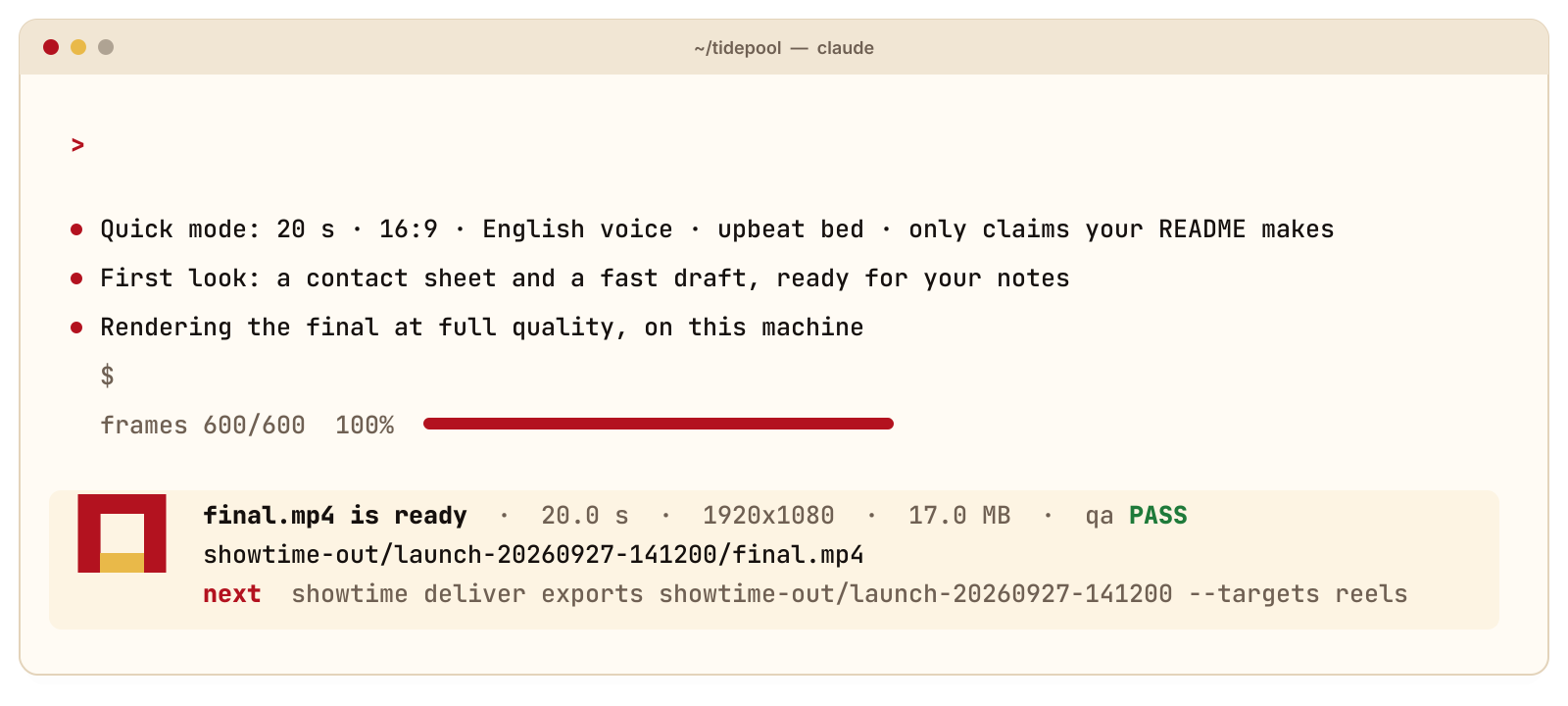
An illustration of a session in Claude Code; other agents show the same steps in their own style. The card's figures are example 01's; render time depends on your machine.
Your agent states its assumptions in one line (it asks only when a request is genuinely open), shows you a
first look (stills or a fast draft) before the full-quality render, then checks the result with
showtime qa. Every request gets its own folder, showtime-out/<name>-<timestamp>/, with final.mp4,
poster.jpg, share.txt, exports/ and work/. Nothing is ever overwritten. Questions about cost, GPUs, disk,
languages or what leaves your machine: the FAQ. Something went wrong:
Troubleshooting. A word you don't know: the glossary.
Tip
Two separate settings. Quick or studio decides how much your agent asks before building: quick (the default) states its assumptions and starts; studio (say "show me options first") shows a concept, a look, a music bed and a storyboard on a local board first. Quality or lean decides how much it checks afterwards: quality (the default) has a critic review every finished video; lean skips the critic unless the video is going to be published. Say "no crew" to keep the whole job in one session.
What's new in 0.4.2 (the list is below, and What's new has a short paragraph for each group):
showtime render --chapters plans the pieces and --join joins them
with a soundtrack built once, so there are none of the loudness steps that joining separately mastered sections gave.--workers auto now picks 6 browsers
instead of 3.voice script --fit S --estimate says up front whether the
narration can fit, and extra local voice engines load by name.On the behaviour scoreboard, 14 one-sentence requests were run 3 times each (42 runs). The same model did the right thing 35 times with showtime and 25 times without. The cases check that it starts on video requests and stays out of others, that it is honest about missing inputs and unsupported claims, and that it keeps to the plan and the delivery card. Anyone can rerun it.
showtime is a skill, a command line and an MCP server, so it runs in any coding agent that reads Agent Skills and can run shell commands. MCP adds typed tools on top, and the ten crew agents are an optional speed-up for hosts that have custom sub-agents.
Tested with. A real run passed: the agent installed showtime from this repository and made a
5-second test video ("make a 5-second test video that says hello", empty folder), ending in a final.mp4
whose showtime qa verdict had no FAIL.
| Agent | Install route | Crew agents | Tested with |
|---|---|---|---|
| Claude Code | plugin | yes | the primary host |
| OpenAI Codex | plugin | with showtime install | CLI 0.158.0, plugin route |
| Cursor | plugin (reads .claude-plugin/) | yes | CLI 2026.09.28 |
| Devin | plugin (reads .claude-plugin/) | yes (local only) | CLI 3000.11.3 |
| OpenCode | showtime install | yes | 1.18.33, a free model |
Should work with any agent that supports Agent Skills: GitHub Copilot (CLI and VS Code), Gemini CLI, Antigravity, Cline, Kilo Code, Kiro, Zed, Goose, Amp, Factory Droid and Qwen Code. The files each one reads are packaged and were checked with the agent's own tools where possible, but no real video has been made in them yet. If you try one, an issue with what happened helps everyone. Exact steps for every agent, and what the tests covered: docs/agents.md.
/plugin marketplace add FavioVazquez/showtime
/plugin install showtime@showtime
Everything is included: the skill, the ten crew agents, the MCP server and the plugin settings (/config).
npx skills add FavioVazquez/showtime
This installs the skill for the agents you pick. Then run setup once from the installed skill folder
(<skills folder>/showtime/bin/showtime setup), and add the MCP server if you want it (below).
Agents often run in a sandbox that blocks a large download, so run setup yourself once, in a normal terminal (it prints the size first and resumes if interrupted):
git clone --depth 1 https://github.com/FavioVazquez/showtime ~/showtime
~/showtime/skills/showtime/bin/showtime setup      # Windows: ~\showtime\skills\showtime\bin\showtime.cmd setup
~/showtime/skills/showtime/bin/showtime doctor     # every line PASS (SKIP is fine)
Setup also writes the stable command ~/.showtime/bin/showtime (Windows: showtime.cmd), which keeps working
when a plugin update moves the skill folder. In the commands below, showtime means that command.
showtime install --agent <name> links the skill where the agent looks, writes the ten crew agents in the
agent's own format and adds a showtime MCP server entry; it merges config files (one backup, never a
replacement), and --print, --project and --uninstall are there too.
codex plugin marketplace add FavioVazquez/showtime
codex plugin add showtime@showtime
showtime install --agent codex --no-skill --no-mcp   # optional: the ten crew agents (~/.codex/agents)
Codex reads the root plugin.json and mcp.json; the skill appears as showtime:showtime. In its default
sandbox, allow network access and write access to ~/.showtime (the exact config.toml lines are in
docs/agents.md). Headless: codex exec --skip-git-repo-check "make a 5-second test video that says hello".
git clone --depth 1 https://github.com/FavioVazquez/showtime ~/.cursor/plugins/local/showtime   # then restart Cursor
agent --plugin-dir ~/.cursor/plugins/local/showtime                                             # the CLI
Cursor reads .claude-plugin/plugin.json: the skill, the crew and the MCP server all load. Without the
plugin: showtime install --agent cursor.
devin plugins install FavioVazquez/showtime        # add --local to keep it off your Devin Cloud plugins
devin plugins info showtime                         # skill, 10 agents, MCP server "showtime"
Devin reads .claude-plugin/. The crew works in the CLI and Devin Desktop, not in Devin Cloud.
showtime install --agent opencode
The skill goes to ~/.agents/skills/showtime, the crew to ~/.config/opencode/agents and the MCP server to
~/.config/opencode/opencode.json. Check with opencode agent list and opencode mcp list.
copilot plugin marketplace add FavioVazquez/showtime
copilot plugin install showtime@showtime
VS Code: run Chat: Install Plugin From Source with https://github.com/FavioVazquez/showtime. Without the
plugin: showtime install --agent copilot.
showtime install --agent gemini
Adds the skill, the crew in Gemini's format and the MCP server. The repository is also a Gemini extension
(gemini extensions install https://github.com/FavioVazquez/showtime), which brings the skill and the MCP
server without the crew.
git clone --depth 1 https://github.com/FavioVazquez/showtime ~/showtime
agy plugin install ~/showtime                     # skill, crew and MCP server
Or, without the plugin: showtime install --agent antigravity.
showtime install --agent cline      # skill + MCP server (no crew: Cline's sub-agents cannot use MCP)
showtime install --agent kilo       # skill; add the MCP server in Kilo's settings with the command it prints
showtime install --agent kiro       # skill, crew and MCP server
showtime install --agent zed        # skill; it prints the context_servers entry to paste into settings.json
showtime install --agent goose      # skill; it prints the extension block for config.yaml
showtime install --agent amp        # or: amp mcp add showtime -- ~/.showtime/bin/showtime mcp
showtime install --agent qwen       # Qwen reads skills only from ~/.qwen/skills
In the Cline VS Code extension, add the MCP server under MCP Servers > Configure MCP Servers (the command
prints the entry), or let Cline follow llms-install.md.
droid plugin marketplace add FavioVazquez/showtime
droid plugin install showtime@showtime
Factory translates the .claude-plugin/ layout. Without the plugin: showtime install --agent factory.
Any client that starts local (stdio) servers can use showtime's MCP server on its own, without the skill. After setup:
{
  "mcpServers": {
    "showtime": { "command": "/home/<you>/.showtime/bin/showtime", "args": ["mcp"] }
  }
}
(Use the full path to that file in your home folder; on Windows it is showtime.cmd in %USERPROFILE%\.showtime\bin, written out in full.) Two more routes need no clone at all:
{ "command": "npx", "args": ["-y", "@faviovazquez/showtime-mcp"] }
is the same server from npm (@faviovazquez/showtime-mcp,
also listed in the MCP Registry
as io.github.FavioVazquez/showtime and on Smithery), and
showtime-0.4.2.mcpb from
the v0.4.2 release opens in Claude Desktop with a double click. Setup still runs once on your machine: the
models and tools never travel inside a package. Long tools answer with a task id after about 20 seconds when a
client stops calls early; the status tool reports progress and the result. Besides the tools that mirror the commands,
guide reads a reference by the piece and receipt writes a job's receipt (tokens and cost are "not reported by this
agent" through MCP). Ten core tools are listed by default (doctor, status, guide, new_project, render,
check, qa, export_html, deliver_exports, receipt), which keeps the list short. Add
"env": { "SHOWTIME_MCP_TOOLS": "all" } to the server entry to list the voice, music, sound-effect, transcription,
stills and studio-board tools too; the .mcpb sets it for you. Some features have no MCP tool yet and run from the
command line: adopt, footage cutout, edit cards, edit moments, edit clips, pr-video, review open and
review notes, and export html's link-preview flags (showtime.json "share" works through export_html).

▶ Watch the 0.2.0 launch film (40 s, MP4; made with showtime, every frame from a real example, about the film). Every example plays in the gallery on the showtime site.
Music: “With These Hands” by Scott Buckley, CC BY 4.0 (credits).
Every example was made by an agent acting as a user, and ships with its project sources and a README
that tells the story: the request, the assumptions, the commands, what the critic found and what
changed. Click a preview to open the example. Each one has a card with its prompt and links in
examples/. Previews are silent; the videos have sound.
 Data story · 30 s 146 years of NASA temperature from a CSV. Every number on screen comes from the data. |
 Energy report · 60 s, narrated How the US power mix changed, from EIA data. Also an HTML video. |
 PDF to summary · 75 s, English + Spanish A two-page USGS PDF on Kīlauea 2018, with the agency's own footage, stabilized. |
 How a heat pump heats a home · 45 s A procedural canvas film, narration fitted to the length, a synthesized score. Also an HTML video. |
 The same film, in Spanish · 51 s Spanish voice and on-screen text, every cut moved to the new narration. Also an HTML video. |
 A Wikipedia article, explained · 60 s, English + French The honey bee waggle dance, with real research footage. Also as HTML videos. (CC BY-SA, like its source.) |
 Why a circle's area is πr² · 70 s + Shorts cut A narrated Manim proof with real animated equations. |
 An explainer that stops and asks · 2:38, narrated The 2026 Nobel Prize in Physics: three questions that stop the HTML video until you answer. |
 Nobel Chemistry, in English and Spanish · 2:30 + 2:34 A lab-notebook explainer of the 2026 Nobel Prize in Chemistry, then every word of it in Spanish. |
 Launch video · 20 s A (fictional) notes app: hook cards, its landing page, a scripted recording of the real app. |
 showtime's own launch video · 30 s + square cut Real renders, real terminal output, narration made on the rendering machine. |
 Product promo, 1:1 · 20 s + 6 s bumper A museum's CC0 photos of a Christopher Dresser teapot, only facts from the record. Also an HTML video. |
 Brand motion pack · sting, lower thirds, stingers A 3D logo sting in three layouts, lower thirds with alpha for an editor, made in studio mode. Also as HTML. |
 Claude Design to MP4 · 12 s + a 20 s loop Two exported designs adopted as they are, sharp at 1080p, each on a music bed that ends on a phrase. |
 Interview, tightened · 72 s, 9:16 + 16:9 A public-domain NASA interview cut by transcript, face-tracked to vertical, graded and captioned. |
 Podcast audiogram · 45 s, 9:16 A NASA podcast clip for Reels, TikTok and Shorts, with speaker names and captions. |
 Talking head, dressed · 55 s, 16:9 + 9:16 Cards that appear as the words are said: name tag, list, data callout, side panel, pull-quote, caption emphasis. |
 A long panel, its best moments · 3 clips, 9:16 A 58-minute NASA panel ranked by edit moments; three vertical clips with captions, each through qa. |
 Recorded tutorial · 50 s Recorded from a running app; each click lands on the word that names it. |
 Tutorial series · 2 × 90 s Two canvas episodes sharing one kit. Also as HTML videos. |
 Tutorial of a real app · 75 s + Shorts cut How to use the showtime studio board, recorded from the real board. |
 Vertical short · 15 s, 9:16 Three shortcuts: a hook in the first second, karaoke captions, effects on every cut. |
 Travel slideshow · 45 s + 9:16 Eight CC0 photos cut to the music, with a live map inset. The vertical is a re-layout, not a crop. |
 Beat-synced montage · 20 s Public-domain NASA photos cut on the beat of a library track; its CC-BY credit written automatically. |
 Studio-mode trailer · 20 s Four concepts on a local board, picks and notes, a storyboard and an animatic, then the final. |
 Book trailer · 30 s + 15 s vertical teaser The War of the Worlds, from public-domain illustrations and lines from the novel. |
 The showreel template in four shapes · 4 × 15 s showtime new showreel as it ships, rendered in four shapes with no edits. |
 Twelve looks, one project · 24 s loop One dom project in all twelve look signatures, the look changing every 2 s. |
 Seven looks, no GPU · 18 s demo The seven WebGL looks, one scene each, drawn in showtime's own WebGL on the CPU. |
 Shutter blur on fast moves · 7.5 s demo data-st-blur on the word that moves: smeared while it is fast, sharp when it lands. |
 |
Open-source release video · 35 s, no voice What changes in people's code with Black 26.1.0's 2026 stable style: real before-and-after diffs, the install line and the changelog. Point showtime at a repo, a pull request or a changelog and it makes the same kind of video. (An unofficial summary, made as an example.) |
 |
A pull request becomes a video · 40 s, one commandshowtime pr-video 7 on showtime's own pull request: the PR's title and words, the files it changed with their +/- counts, a real hunk and its URL, secrets masked, a copy under GitHub's 10 MB attachment limit and the Markdown to paste. |
Two more kinds of developer video have a workflow but no example in this gallery yet: a repo explainer (what the
code does, a map of it, one request traced through real files and lines, every claim tied to a file and a commit) and
a paper explainer (claims tied to pages, figures shown only when their license allows, Manim for the math). Say
"explain this repo" or give your agent a paper's PDF or arXiv link. For a pull request, showtime pr-video <N> reads
it (with gh, or from GitHub's API for a public one) and renders a video under 10 MB to drag into its description
(example 29). For release notes and pull requests with no agent at all,
showtime release-video and the GitHub Action make a short film in CI.
All 22 examples, with their projects and full-quality videos, live in showtime-examples.
Note
The HTML videos are single files you can open in any browser, offline: the same frames as the MP4, a player with chapters, keyboard shortcuts, links to a moment or to a part that loops, questions that pause the video until the viewer answers, and no network requests. Make one from any project with
showtime export html. On GitHub, download the file to play it.
| # | Prompt |
|---|---|
| 01 | Make a 20-second launch video for Tidepool from its landing page and the real app UI, with music and subtle sound effects, no voice-over. |
| 02 | Make a 45-second explainer video with voiceover about how a heat pump heats a home in winter. |
| 03 | Now make the Spanish version of the heat pump explainer. |
| 04 | Make a 40-60 second tutorial showing how to create a note, tag it and find it with search in Tidepool. |
| 05 | Make a 15-second vertical short for Reels: 3 keyboard shortcuts that make Tidepool fast. |
| 06 | Cut the ums and long pauses out of this interview clip, add captions, and make a vertical 9:16 version for Reels plus a 16:9 version. |
| 07 | Make a 30-second data story from this CSV. |
| 08 | Make a 20-second beat-synced montage of space photos. |
| 09 | Let's brainstorm a trailer for Tidepool first. Show me options. |
| 10 | Make a 30-second launch video for showtime itself. Show real things: real renders, real terminal commands, the studio board. Plus a square cut-down. |
| 11 | Build a two-episode tutorial series for Tidepool as canvas films: "Capture a note in seconds" and "Find anything with search and tags". |
| 12 | Make a one-minute narrated video from the EIA's electricity generation data showing how the US power mix changed: coal, gas, wind and solar. |
| 13 | Turn the Wikipedia article on the waggle dance into a 60-second animated explainer, and make a French version too. |
| 14 | Here's a USGS PDF about the 2018 Kīlauea eruption. Make a 75-second narrated summary video, and a Spanish version with subtitles. |
| 15 | Make a 35-second what's-new video for Black 26.1.0: show what the 2026 stable style actually changes in people's code. |
| 16 | Cut a 40-second vertical audiogram from this NASA podcast episode for Reels, TikTok and Shorts, with captions and the speakers' names. |
| 17 | Make a 20-second square product promo from these museum photos of Christopher Dresser's teapot: sleek, but only facts from the museum record. Plus a 6-second bumper. |
| 18 | Make a 30-second cinematic book trailer for The War of the Worlds using public-domain illustrations and lines from the novel, plus a vertical 15-second teaser. |
| 19 | Make a 45-second travel slideshow of an Iceland ring-road trip from these CC0 photos, cut to the music, with a little map showing where each place is. Also a vertical version for Reels. |
| 20 | Using our brand, give me a motion pack: a 3D logo sting in wide, square and vertical, four lower thirds my editor can drop into Premiere, and a couple of branded transitions. Show me concepts first. |
| 21 | Record a 75-second narrated tutorial showing how to use the showtime studio board: open it, compare concepts, react, pick one, and send feedback. And a vertical cut for Shorts. |
| 22 | Make a narrated 70-second math explainer showing why the area of a circle is pi r squared, with real animated equations. |
| 23 | Dress up this NASA interview with Sarah Jones about the GOLD mission: name tag, a data callout, a pull-quote, a list or chapter, a side panel and captions with emphasis; a 16:9 and a 9:16 cut. |
| 24 | Find the best 30-60 s moments of this 58-minute NASA panel (Apollo 17 legends and Artemis leaders) and make three vertical clips with captions |
| 25 | Physics 2026 explainer for nobel-2026-lab: a telescope made of ice, ~2 min, three stop-and-ask questions, interactive export, 60 s vertical cut; publish today |
| 26 | Full Chemistry 2026 explainer (~2:10, 16:9) for the nobel-2026-lab: Frank's recipe, Kagan's bend, Soai's copier, the 2003 staircase, the coin flip, our mirror-race toy, caveats, medicines. NOT socratic: no questions to the viewer. American voice (af_bella; not the British female). Paperback lab-notebook look, CC0 bed, showtime credited (corner mark, end card, closing line). Must look great; post soon. |
| 28 | Make 'Showtime Test (12s, 16 9)-html.zip' an MP4, with a music bed. |
| 29 | Turn showtime's pull request #7 into a short video I can paste into its description. |
| 30 | Render the showreel template as it ships, with no edits, at 16:9, 9:16, 1:1 and 4:5. |
| 32 | Show one project in each of the twelve look signatures: a contact sheet of all twelve, and a 24-second loop that changes look every 2 seconds. |
| _looks | Show the seven WebGL looks in one short page, one scene each, rendered without a GPU. |
| _blur | Show the shutter blur on four snaps: a whip, a slam, a scale punch, and the same whip without and with it. |

Motion graphics are written as HTML, CSS and canvas and rendered frame-exactly in headless Chrome: every frame is a pure function of time, so a render, its preview and its HTML video show the same picture. Math scenes use Manim, and real footage is cut by transcript with ffmpeg.

showtime adds no cloud service of its own: no API keys, no accounts, nothing you make is uploaded.
Every model and tool is downloaded once into ~/.showtime, the small ones at setup and the bigger ones the
first time a video needs them. After that it goes online only when you ask for something from the web: public-archive media search (Openverse, Wikimedia Commons, NASA) and website
capture fetch pages and files, and send nothing of yours.
Every job follows the same order: check the project, render once, then fix only the seconds that changed. Output stays short and images stay out of your agent's context, so a video costs fewer tokens without skipping a check. Here is how (most of it came in 0.3.0, after the 0.2.0 benchmark showed where an agent's budget went):
showtime check (with the phone check and the look-repeat warning) runs before
the full render, and a fix re-renders only the seconds that changed (render --from S --to S).showtime look makes a single 1280 px composite of the key frames plus a brief for a
disposable reviewer that answers in text; your agent never has to open the image itself. About 12 images per job
is the budget (looking guide).check, qa, doctor and render print the verdict, the findings with
their fixes and the paths; the full report is in a file. --verbose prints everything.showtime guide <topic> [section] prints just
that part.receipt.md and receipt.json: the request as typed, assumptions, review rounds,
full and partial renders, images made for looking, wall time, and tokens and cost when your agent's session log is
named. Anything unknown says "not reported by this agent"; nothing is estimated. Claude Code costs are labelled
API-equivalent, since a plan does not pay per video (format).Every finished video gets the full review by default (quality mode: looks, qa and a critic round before delivery).
Say "lean" (or run showtime config mode lean) for a cheaper draft pass without the critic, and "show me options
first" for the full studio.
A small benchmark: one-sentence video tasks, one run each, scored by automatic checks, an AI judge that must prove it looked at every frame, and a blind vote by me. Round 4 compared showtime 0.3.0 in lean mode (the lighter review setting, which was the default when the round ran) with 0.2.0 in its default mode, plain Claude Code on Opus 5.5 and, for the launch video, an open-source tool built only for launch videos.
In my blind vote, 0.3.0 was preferred to 0.2.0 on 4 of 6 tasks and to plain Claude Code on 7 of 8, and its launch
video beat the launch-only tool for the first time in four rounds. The AI judge preferred 0.2.0's polish on most
tasks; that is why 0.3.0 ships with the full review (a critic round on every video) as the default, and that default
was not part of the round. I'm showtime's author, so treat these as anecdotes, not a result. Every number, limit and
loss is in the benchmark report, with each earlier version a
click away; the method and the code to rerun it are in benchmarks/.
A cheaper check anyone can rerun with one command: 14 one-sentence requests run through claude plugin eval, each
with showtime and with no plugin at all (same model). Does the skill fire on video requests and stay out of
unrelated ones, does it report a missing file or an unsupported claim instead of inventing around it, and does it
keep its contract? Regex and tool-call checks first, a model grader only where a pattern cannot decide; tokens and
cost per run, and every failure in plain words, are in SCOREBOARD.md.
| Behaviour | Cases | With showtime | Without (same model, no plugin) |
|---|---|---|---|
| Skill fires on a video request | 12 | 36/36 (100%) | - |
| Stays out of unrelated requests | 2 | 6/6 (100%) | 6/6 (100%) |
| Honest about inputs and limits | 7 | 18/21 (86%) | 10/21 (48%) |
| Keeps the contract (questions, card, plan shape) | 7 | 16/21 (76%) | 11/21 (52%) |
| All cases | 14 | 35/42 (83%) | 25/42 (60%) |
claude plugin eval, 2026-10-05, showtime 0.4.0, agent claude-opus-5-5, judge sonnet, 3 runs per case per arm; median tokens per run 65.3k with showtime, 34.7k without; the whole run cost $36.00 at list price. Every case, every failure and how to rerun it: SCOREBOARD.md.
Your agent is the director. It can hand parts of the job to ten specialist sub-agents that ship with the plugin. Every finished video gets a critic by default (quality mode); say "lean" to skip it (a video you will publish still gets one). A researcher joins when the video states facts or you will publish it, a sound designer when you will publish it and it has music or effects, and scene builders when it is long. The rest come with studio mode, or when you say "full crew". Each member gets a written brief, works only in its own folder, never asks you anything, never uploads, and reports back with a short status.
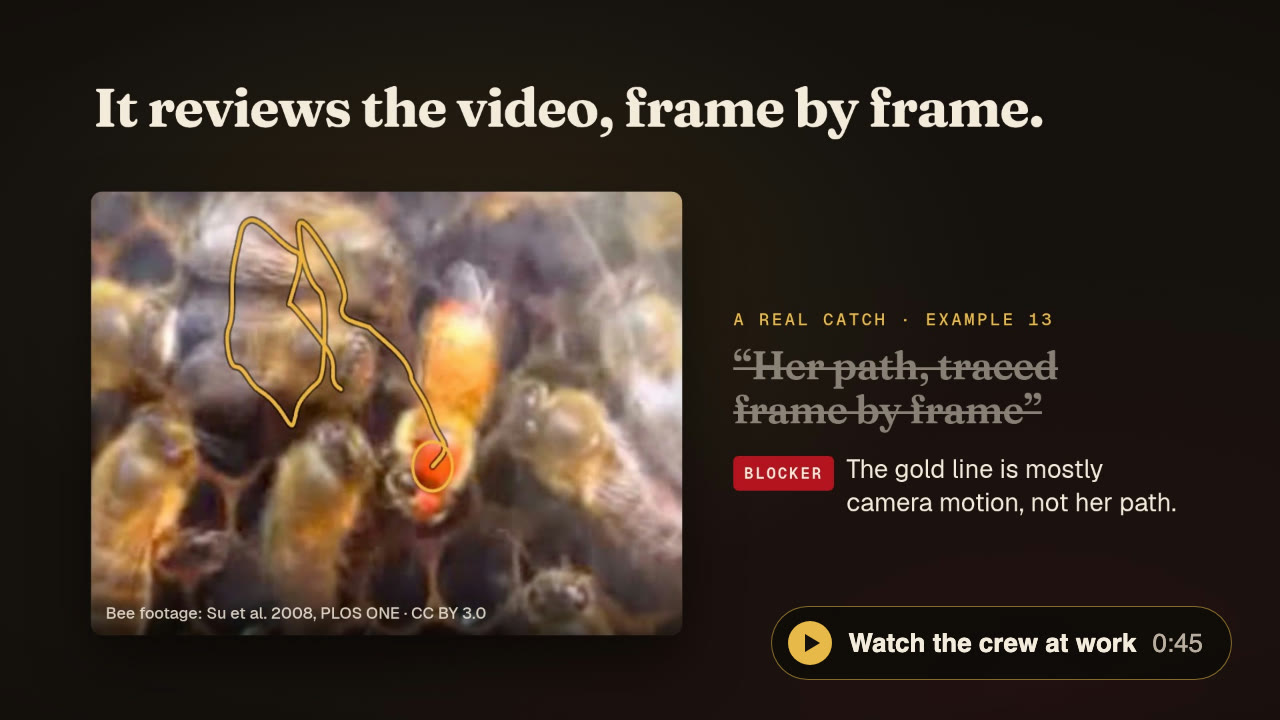
▶ Watch the crew at work (45 s, plays on the showtime site; made with showtime, about the film, download).
Music: “Artemis” by Scott Buckley, CC BY 4.0. Bee footage: Su et al. 2008, CC BY 3.0 (credits).


Let your agent cast it (the usual way). Studio mode brings in the company; for a quick video, your agent adds the critic on its own, the researcher when the video states facts or you will publish it, and the sound designer when you will publish it and it has music or effects. Say "full crew" to get every member the job can use without the pitch step, or "no crew" to keep everything in one session. The words that set each mode:
| You say | Mode | Crew |
|---|---|---|
| (nothing special) | quick, quality review | critic; researcher for facts or publish-bound; sound designer for publish-bound with music or effects; motion designers at 6+ scenes |
| "lean", "quick draft", "don't review" | quick, lean | none; a critic only when publish-bound |
| "full crew", "use the whole crew" | quick, full crew | every member the job can use, critic twice |
| "studio", "show me concepts first", "storyboard it first" | studio | pitch, storyboard gate, full crew |
| "no crew" | any | done inline |
Let's make a launch trailer for this repo. Show me options first.
Or call one member yourself, by name (Claude Code syntax; in other agents, ask it to "spawn the researcher agent"):
@agent-showtime:researcher check the claims in narration.md against the README
@agent-showtime:critic showtime-out/<job>/review/round-1/CRITIC.md
The agents live in agents/; their briefs, in
skills/showtime/references/crew/, work on any agent host, and the
crew guide has the dispatch rules.
A fix is judged by preference, not by a score. After a fix, showtime review-pack --against best
sets the new render beside the best one so far as a blind pair, and two fresh critics judge it, one in each order.
showtime review-verdict applies the rule: the new render wins only when it is preferred both times; a tie or a split
keeps the older one. There are up to three rounds. Before the job is marked delivered, every blocker and should-fix the
critics raised is fixed or waived with a one-line reason (showtime review-respond), and the receipt lists each waiver
(review guide).
Quick mode is the default: one request in, a video out. Studio is opt-in ("show me options first").
flowchart LR
  R["Your request"] --> Q{"Options first?"}
  Q -->|"no, the default"| QM["Quick mode"]
  Q -->|"yes, studio"| SM["Studio mode"]
  QM --> P{"Facts, or will you publish it?"}
  P -->|"yes"| RS["A researcher joins"]
  P -->|"no"| D["Checked by showtime qa"]
  RS --> D
  SM --> CR["The crew joins"]
  CR --> D
  D --> RC["A critic reviews it (say lean to skip)"]
  classDef st fill:#15100E,stroke:#E9B949,color:#F5EBDC
  classDef hot fill:#B3121F,stroke:#E9B949,color:#FFF7EC
  class R,Q,QM,SM,P,RS,CR,RC st
  class D hot
Quick mode is one sentence in and a video out; studio mode opens a local board first, then builds.
In studio you talk about facts and goals in chat; everything about look, sound and timing is shown on a
board, a local page served on 127.0.0.1 with a token, with lettered options, one recommendation and
buttons you click.

See example 09 and example 21, which is a tutorial of the board itself.

showtime export html writes one file that plays offline in any browser, with the same frames as the
render. Press ? in the player for the key map. A link can open a moment (#t=18) or loop a part
(#t=10-20; Shift + drag on the scrubber picks one), and questions listed in showtime.json pause the
video until the viewer answers (guide).

| Keys | Action |
|---|---|
| Space or K | play / pause |
| ← / → | back / forward 1 s |
| , / . | one frame back / forward |
| J / L | back / forward 5 s |
| 1 to 9 | jump to a chapter |
| [ / ] | previous / next chapter |
| M | mute |
| F | fullscreen |
| C | copy a link to this moment (#t=), or to the picked range (#t=a-b) |
| Shift + drag on the scrubber | pick a range to loop and link (Shift + click: from the playhead); Esc clears it |
| A-C or 1-3, Enter | while a question is asked: answer it, then continue |
 Voice-over Kokoro, Piper and Supertonic voices, English, Spanish and 30+ more languages, with exact word timings for captions and kinetic type. |
 Music and sound 297 produced tracks (Scott Buckley, Kevin MacLeod, a dozen more composers, public-domain recordings) with the credit written for you, a composer that hits exact lengths, 56 synthesized effect types, 1,334 permissively licensed sounds, beat grids, ducking, mastering. |
 Captions Five styles, burned in or as SRT/VTT, placed inside each platform's safe zone; karaoke from the voice's word times. |
 Footage editing Word-level local transcripts that keep the ums; cut fillers and pauses by editing text; speakers, scenes, face-tracked 9:16, stabilize, denoise, grade. |
 Math with Manim Equations, proofs, graphs and grid transforms, timed to the narration, as an optional extra. |
 Studio boards Concepts, style frames, music beds, a storyboard and an animatic on local pages you click through; picks are logged. |
 A crew of ten Optional specialist sub-agents from creative director to critic; your agent stays the director and the only one who talks to you. |
 HTML videos One self-contained file per video: chapters, keyboard control, links to a moment or a looping part, questions that wait for the viewer's answer, zero network requests. |
 QA before done Pre-render checks and a phone check, then showtime qa on the final: loudness, black or frozen frames, captions, platform specs, and a hearing pass (a voice buried under the music, long quiet stretches, jumps in level at a cut, sound cut off at the end). |
Looks and motion blur Seven WebGL looks (fluted glass, tilt-shift, liquid metal, mesh gradient, god rays, marble, metaballs) and a shutter blur on fast moves, all rendered without a GPU (demo). |
Talking heads Cards that appear as the words are said (name tag, list, data callout, pull-quote, side panel), caption emphasis, and a big word behind the speaker, cut out on the CPU. |
Long recordings to clips A podcast, talk or panel ranked for its best moments on your machine, then the ones you pick as captioned vertical clips, each checked by qa. |
Also: 30 motion components (seven of them WebGL looks), 26 transitions (15 CSS, 11 WebGL) and 6 themes, 12 look signatures that new
dom, launch, short and data projects start in (a palette, a type pair and a motion feel, picked away from your
recent videos; showtime signature), a showreel template for a dense 15-second reel, website capture
(screenshots, copy, brand colours and fonts), scripted app recordings with smooth auto-zoom, cursor and keycaps, PDF import, CSV and JSON to charts, a brand kit, posters baked into frame
0, exports for YouTube, X, LinkedIn, Reels, TikTok, Shorts and square feeds, README loops (animated WebP
and GIF, like the previews on this page), credits written automatically when an asset needs
attribution, a look history so videos do not repeat, style references, adopting video code you already wrote or a
Claude Design export (showtime adopt), and a receipt for every job.
showtime --help lists them grouped, with examples; showtime <command> --help has the details.
| Group | Commands |
|---|---|
| Make | new (templates: data, dom, film, launch, series, short, showreel, tutorial, manim), adopt, release-video, pr-video, retime, data, preview, render, export, check, snap, look, score, motion, code, server, manim |
| Audio | audio compose, sfx, lib, beats, fit, mix, meter, master |
| Voice | voice say, voice script (narration with word timings, fitted to a length) |
| Footage | transcribe, pack, edit (cut, check, render, view, cards, moments, clips), captions, footage (scenes, reframe, cutout, denoise, stabilize, grade and more), autozoom |
| Capture and assets | site, demo, doc, assets (font --css <Google Fonts link> copies a stylesheet's fonts with their licences) |
| Studio | studio, brand (init, capture, apply, skip) |
| Job and QA | status, qa, review-pack, review-findings, review-verdict, review-respond, review (open, notes: notes on the finished video), receipt, history, reference, job, clean |
| Deliver | deliver (posters, platform exports, thumbnails, README loops) |
| Setup | setup, doctor, config, install, report, paths, version, mcp, guide, help |
| More | series (a tutorial series sharing one kit), signature (the look signatures: list, apply) |
showtime new dom my-video --duration 20     # a project from a template
showtime voice script my-video/narration.md -o my-video/voice --fit 18   # local narration, fitted to 18 s
showtime retime my-video --from-voice my-video/voice/timeline.json         # scenes follow the narration
showtime data import signups.csv my-video --x month --y signups --scene bars   # a CSV becomes a chart
showtime preview my-video                    # live player with scrubber and audio
showtime render my-video --preview           # fast draft
showtime render my-video -o final.mp4        # full quality
showtime qa final.mp4                        # PASS/WARN/FAIL: loudness, black/frozen frames, captions, platform
showtime deliver exports final.mp4 --targets youtube,reels,square
showtime export html my-video                # a single-file interactive HTML video
showtime look my-video                       # one composite of the key frames, for a quick visual check
showtime reference clip.mp4 --job my-job     # a video's pace, shots and type scale, as a brief (never its content)
showtime adopt my-page/                      # a page that already has seek(t) gets check, sound, qa and export
showtime adopt design-html.zip               # a Claude Design animation's HTML export to a 1080p video, its fonts local
showtime release-video notes.md -o my-video  # release notes to a ready-to-render project, no agent needed
showtime pr-video 123                        # a pull request to a video under 10 MB for its description
showtime review open my-job                  # a local page to leave notes on frames or stretches of the finished video
showtime edit cards suggest edit/transcripts/talk.json   # moments in a talking head for cards (name tag, quote, list)
showtime footage cutout talk.mp4             # the speaker cut out on the CPU: a video with alpha, a matte, a sheet
showtime edit moments my-job                 # a long recording's best moments for short clips, ranked locally
showtime edit clips my-job --pick m1,m3      # the picked moments as finished 9:16 clips, each through qa
showtime assets font --css "https://fonts.googleapis.com/css2?family=Anton" --copy-to my-video/fonts
Everything is local and license-gated: no sample leaves your machine, and an asset that needs
attribution writes itself into credits.txt. Catalog tracks are downloaded from their creators on first use
(with the size announced) and never re-hosted here.
| Command | What it does |
|---|---|
audio compose | procedural music to an exact length in 18 styles, with stems, MIDI and a beat map; restrained beds for explainers and data, livelier styles on request |
audio sfx | 56 synthesized effect types (whooshes, hits, UI clicks, risers), with the hit time printed |
audio music | the produced-music catalog: 297 tracks, each measured for quality and tagged by mood, energy and tempo; audio music pick --for launch --dur 45 chooses one, and the credit lands in credits.txt and the post copy by itself |
audio lib | the local library, 1,334 sounds: CC0 effects and ambiences, CC-BY music beds credited automatically, and beds rendered on your machine; audio packs adds 35 more sound packs (34 CC0, 1 CC BY) on demand |
audio beats | beats, downbeats, onsets, energy, sections and key, so cuts land on the music |
audio fit | loops or trims music to a length on bar lines |
audio mix | one mix file: ducking under the voice, effects aligned to hits, loudness |
audio meter, audio master | LUFS, true peak and loudness range; mastering to -14 LUFS / -1 dBTP by default |
showtime manim new|render|check|cues makes equations, proofs, graphs and grid transforms with Manim
Community (the manim extra; LaTeX is needed only for equations), and times them to the narration.
Example 22 cuts a circle into rings, unrolls them into a triangle and
lands on
$$A = \tfrac{1}{2} \cdot 2\pi r \cdot r = \pi r^2$$
with a vertical cut for Shorts from the same scenes. An optional OpenGL engine (the manimgl extra) runs
scene files written for it. showtime manim check also renders a draft and runs qa's black-frame and frozen-frame
detectors on it, so a near-black scene or a barely visible change is reported before the full render.
What's new has a short paragraph for each group of them.
Render
showtime render --chapters plans the pieces from your chapters (or the film's acts),
--chapter N --job J renders one, and --join --job J joins them and builds the soundtrack once for the whole
video, so there are none of the loudness steps (2.6 and 0.7 dB) that joining separately mastered sections gave.
Every seam is checked against a master before the file is named final.mp4, and after a whole render or a
join a later fix to one chapter re-renders exactly its frames. On one machine a whole render is faster: use
chapters for a second machine (not measured), a later fix of one chapter, or a long film (render § Speed, issue #22).--scale 2 real
on a Mac. A page with the wrong size is set again and render.log says so
(render, issue #49).--gpu off) instead of shipping
white.--workers auto uses CPU threads - 2 from 8 threads up (at most 8,
within the frame, memory and SHOWTIME_MAX_WORKERS limits): on an 8-thread machine it picks 6 browsers instead of
3; with a GPU nothing changes (issue #41, FAQ).Footage and voice
edit render keeps the sound in sync on showtime's own renders: a range could come out with its sound up to
21 ms early (issue #38).showtime voice script narration.md -o voice --fit 15 --estimate says up front whether
the narration can fit before it synthesizes a single line.doctor no longer fails on Kokoro when you chose
another (voice, issue #8).Help
showtime doctor ends with a link to the
troubleshooting page when a check fails, and the site's docs start on "Start here"
(your first video, troubleshooting,
glossary).
What's new has one sentence and a picture for each.
Look and motion
data-st-blur smears an element the way a camera shutter would, only on the frames it moves fast;
it lands sharp (stage-api, the demo, the flash
words of example 30).Footage
showtime footage cutout cuts a person out on the CPU (MODNet, Apache-2.0), and the
EDL card behind puts a big word between the background and the speaker.showtime edit moments ranks whole-sentence moments by local signals (a
hook, a complete thought, energy, laughter and applause, one topic) and showtime edit clips renders the picked
ones as face-tracked 9:16 clips with captions, each through qa: a 58-minute panel took about 7 minutes end to end
on a 64-core machine (example 24).New ways in, and sharing
showtime adopt <export.zip>: the artboard fills a 1080p frame with sharp text, its
Google Fonts are copied in with their licences, and a looping design renders exactly one loop
(adopt, example 28).showtime export html --share-url <address> (or "share" in showtime.json) adds the tags that
show a title, a description and the poster when the link is pasted; --folder exports are ready for GitHub Pages
(example 25's HTML video).Review and resume
showtime review notes names the
scene and the elements under each note.showtime status <job> lists the files you edited by hand, your unread notes and open
findings, so your agent keeps your changes.showtime setup --fetch parakeet-tdt-0.6b-v3-int8.caption_zone warns about anything where
the captions go, a WebGPU page is tried again without WebGPU, and each look's cost is estimated.Faster
The full list is in the changelog.
Videos that ask, and notes on the finished video
showtime review open <job> serves a local page that plays the latest render:
pause, click a spot or drag a box on the frame, type a note. Your agent reads them with showtime review notes,
fixes, and replies on the same note.video.html#t=10-20 plays that part on a loop.New ways in
showtime pr-video <N | URL>: a pull request becomes a short video for its own description in one command,
with a copy under GitHub's 10 MB attachment limit. A public PR works without a GitHub login, and values that look
like secrets never reach the video (example 29).showtime new <template> <dir> --from-storyboard FILE
reads a Markdown table (Shot | Length | Visual | Narration, in any order, English or Chinese headers;
examples 25 and 26).qa judges density, the ending and repeats.
The showreel template renders at 16:9, 9:16, 1:1 and 4:5 with no edits (example 30).A stricter quality gate
showtime review-respond --fixed | --waive), and every waiver keeps its reason in the receipt.Look: line saying what was opened, at what size, and what was seen.Better-looking by default
showtime new dresses the page templates in one of twelve curated looks (palette at
the contrast rules, a type pair, a motion feel), picked away from your recent videos (--look <id> to choose;
example 32 shows one project in all twelve).<video>: every video is drawn on a canvas in renders, and
check warns late_first_frame.Proof
Limits: the hearing pass and the checks measure the file; whether a video is good is still the critic's and your call. The full list is in the changelog.
Quieter runs, full review by default
showtime config mode lean) for a lighter pass without the critic round. In both modes showtime look makes one
composite image that a disposable reviewer reads (your agent does not), render says when a project was not
checked first and names the cheaper --from/--to fix after a second full render, and check, qa, doctor and
render print a short summary by default (--verbose for everything). Every reference opens with its rules
(showtime guide <topic> prints them). No check was removed. In benchmark round 4, lean runs read a median of 4.5
images into the agent's context and made a median of one full render per job.showtime job init checks your setup and prints setup: ready or the failures with their fixes, so it is the
one command to start with.Better videos
showtime history off turns it off).
showtime check warns look_repeat when a project repeats one of the last five, with two concrete alternatives.showtime reference <video> writes a brief with the video's cut rhythm, shot lengths, how
scenes change, palette, camera moves, rough type scale and loudness curve, and a contact sheet. The storyboard
borrows the grammar, never the words, logos or shots; the credit "Style reference: ..." is written for you, and
showtime qa fails a render that copies the reference's pictures (guide).showtime check ends with phone check: PASS or FAIL with timestamps: each text held long
enough to read (per language), a minimum type size at phone width (16:9 5 pt, 1:1 10, 4:5 11, 9:16 15) and nothing
under a platform's buttons or at the edge. In qa, a failure is a warning, never a FAIL.showtime brand capture <repo|url> --job <job> takes the product's palette with
roles, fonts, logo, wordmark, real copy (with file and line) and real UI before the storyboard, and showtime new launch applies it. A launch job with no kit says why (showtime brand skip), and check warns when it does not.retime --from-voice --total works when every scene is narrated, Manim silent films and --mix paths work, doctor
warns when the showtime command on your path is not the agent's, and font errors name the exact missing
characters and the fix.New kinds of video
repo-explainer and paper-explainer), described
above.showtime release-video turns release notes, a CHANGELOG section or a PR description into a ready-to-render
project with no agent: the notes' own words, reading-time holds, the people credited.showtime adopt <folder | page | script> takes a video someone already wrote as a function of time (an HTML
page with seek(t), a canvas draw(t), a CSS-animated page, a Python frame function) and gives it showtime's checks,
sound, captions, qa, HTML export and review, without a rewrite. The originals are never changed
(guide).Honesty
receipt.md, receipt.json and a line in share.txt (see
above).In progress (landing before the release):
render --from A --to B --job <job>) splices into a complete new final: only those frames change, the audio is mastered again, and a span is never mistaken for the video.Limits: the phone check and the look history read the project files and cannot judge whether a video is good; a model reviewer's preference is steadier than its score but is still an opinion; tokens and cost appear only for agents that expose their session log (Claude Code and Codex, as numbers only), and everything else says "not reported by this agent". The full list is in the changelog.
showtime install --agent <name> puts the skill, the crew
and the MCP server where an agent looks. A stable ~/.showtime/bin/showtime command survives plugin updates,
long commands can run in the background (--background, showtime status), and showtime doctor knows the
sandboxes of the common agents and says which setting to change.showtime setup --plan lists every component with its size and when it is
fetched, and showtime setup --full installs everything up front. Nothing was removed: a piece that left the
default install (the transcription model, Manim, the audio library beyond its 41 MB starter, browser and icon
extras) is fetched the first time a video needs it, announced with its size. Homes made by 0.1 keep working;
setup --prune clears what is no longer used.showtime audio music pick. Tracks are fetched from their creators on first use
and never re-hosted. Every render that uses one writes the credit into credits.txt and the post copy by
itself, and prints a note. 35 more sound packs (34 CC0) install when a search needs them.scripts/e2e.py repeats the whole
path on any machine.showtime preview and showtime server answer only requests that carry a
random per-session key from the printed link; before, any web page open in your browser could read a
project's files over 127.0.0.1.--model). It keeps "um" and "uh" as words, and a scan after it hears the hesitations no word covers. On a public,
human-labelled podcast set (20 episodes, 495 labelled fillers) it found 81% of them at 83% precision against the
labels, where 0.1.0's default found 11% at 78%; on the benchmark interview it cuts all five known "uh" (the
benchmark's scorer credits 4 of 5; 0.1.0's default commands cut none). Cuts get 20 ms crossfades. Speech under
music is heard better because showtime transcribes its own dry narration stem, and separates the voice only when
the music is loud: word errors at equal loudness fell from 19.7% to 7.3% on a small test set. These are local
evaluations on a few sets, not a guarantee for your footage; label-based precision understates it, since the
labels miss some real fillers. CrisperWhisper is available as an opt-in model under its non-commercial licence
(not on Intel Macs).showtime check stops a
render when text would be cut off.The full list is in the changelog.
No GPU needed. Without one, the browser draws every frame on the CPU, WebGL included; how long that takes, and other common questions, are in the FAQ.
showtime is built for macOS (Apple Silicon and Intel), Windows 10/11 and Linux (x86_64 and arm64). What has actually been run, and where ("end to end" means setup, doctor, a voiced render with qa, HTML export, transcription, captions and the MCP server):
macos-14 (M1) runners, plus the fast suite. A run on a physical
Apple Silicon Mac is still welcome.Draw and visually collaborate with your agents on tldraw's canvas.
TLtldraw/tldraw51k近 7 天新增 105 个 star
Search your local screen recordings, audio transcripts, and computer activity from screenpipe.
SCscreenpipe/screenpipe22k近 7 天新增 99 个 star
Transcribe local audio with FunASR and SenseVoice using private, on-device inference.
MOmodelscope/FunASR21k近 7 天新增 65 个 star
AI Skills, MCP Tools, and CLI for Unity Engine. Full AI develop and test loop. Use cli for quick setup. Efficient token usage, advanced tools. Any C# method may be turned into a tool by a single line. Works with Claude Code, Gemini, Copilot, Cursor and any other absolutely for free.
IVIvanMurzak/Unity-MCP4.4k近 7 天新增 37 个 star