
Netdata
Real-time infrastructure monitoring with metrics, logs, alerts, and ML-based anomaly detection.
NEnetdata/netdata81k近 7 天新增 110 个 star
Computer use for your agents across the Omarchy machines you own. Open source MCP server.
Give your agents a computer you own.
ibara gives your agents computer use across the Omarchy machines you own. Put a spare computer to work: your agent gets its own desktop, browser and apps, and you keep working on yours.
ibara.app · Docs · Benchmarks · Roadmap

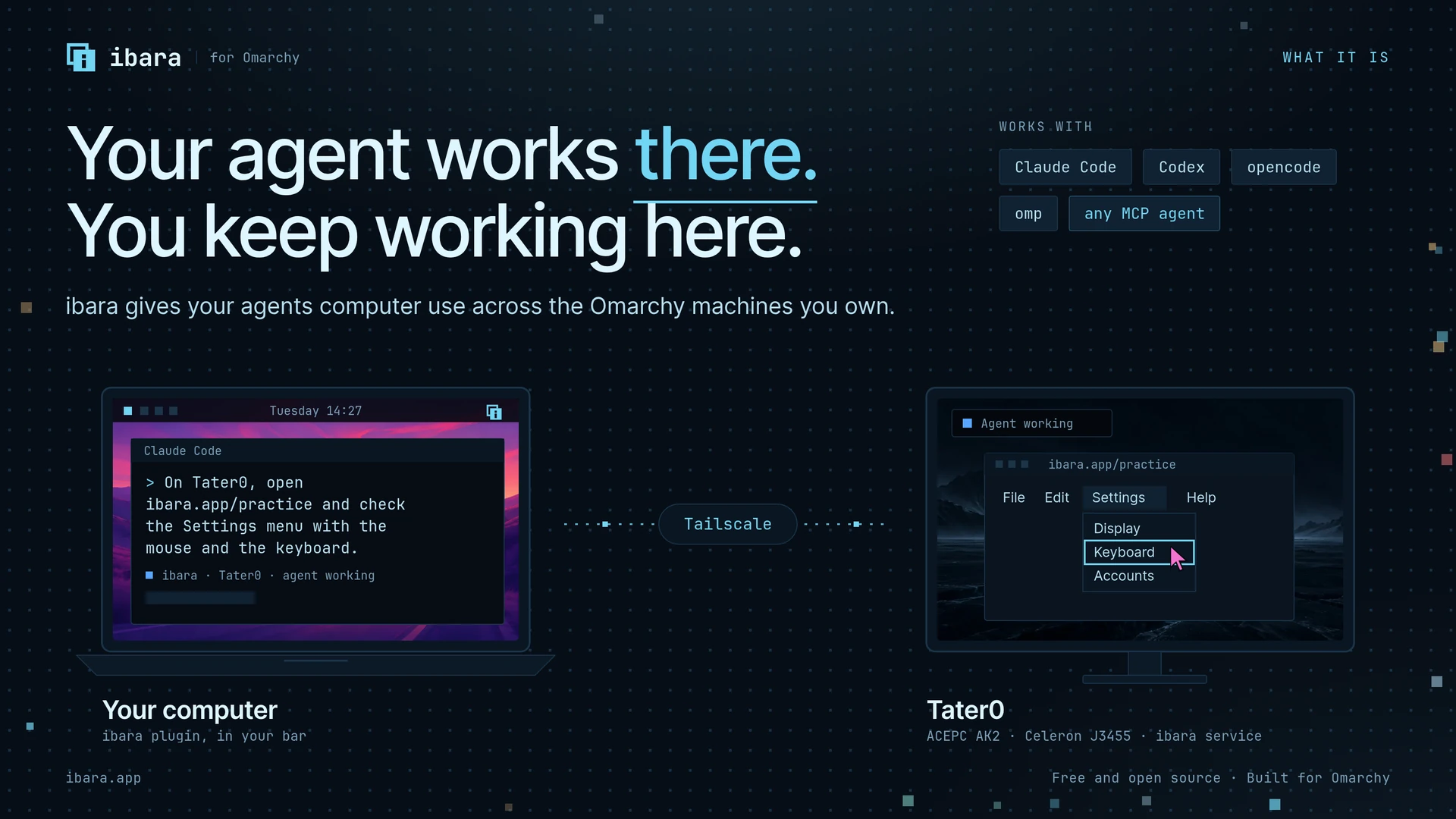
Every computer you add shows up as a live picture in a console on the others, where you can watch it, send it files and take control of it. Your agents work on those computers' real desktops, with their own cursor, while you approve what matters and step in whenever you like.
ibara runs on Omarchy (Arch Linux with Hyprland). Ubuntu 26.04 amd64 has separate standalone Console and GNOME target packages; see Ubuntu installation and compatibility. Your computers reach each other over your own Tailscale network. It is free and open source.
Want it set up for you? Cirlet offers paid setup and support.
On an Omarchy computer, run this as yourself, not as root:
curl -fsSL https://github.com/MayberryDT/ibara/releases/latest/download/install | sh
The installer downloads the newest release and checks its signature and each package's digest. It installs 3 packages with pacman: ibara, and ibara-stream and ibara-view for Take Control. Then it runs ibara setup, which asks for your password once and puts the ibara mark in your bar.
Install ibara on each computer you want to use, then open the console from the bar and choose Add Computer. Your own computers on your tailnet add each other in one step.
To check a release by hand before you install it, see release verification.
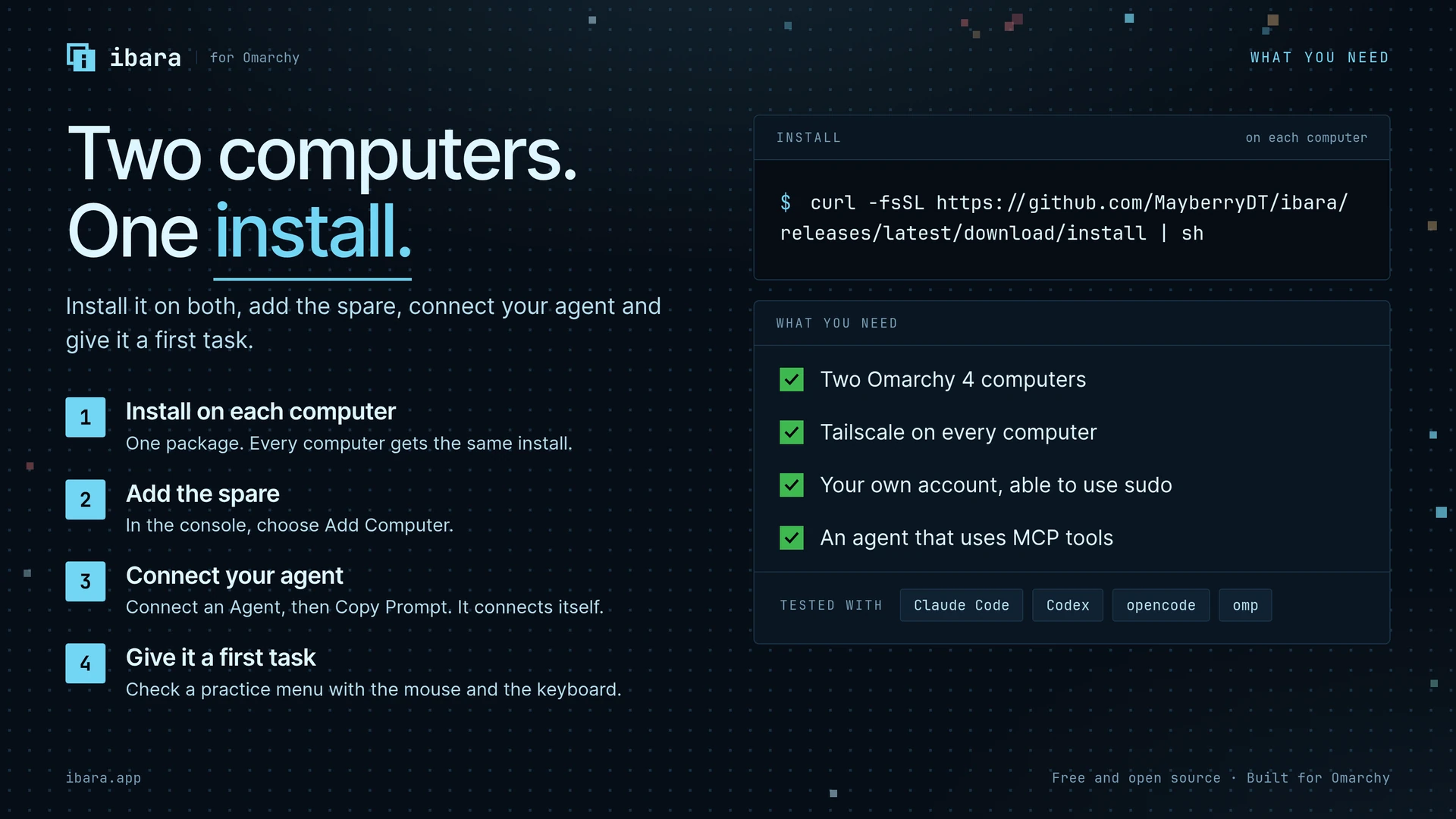
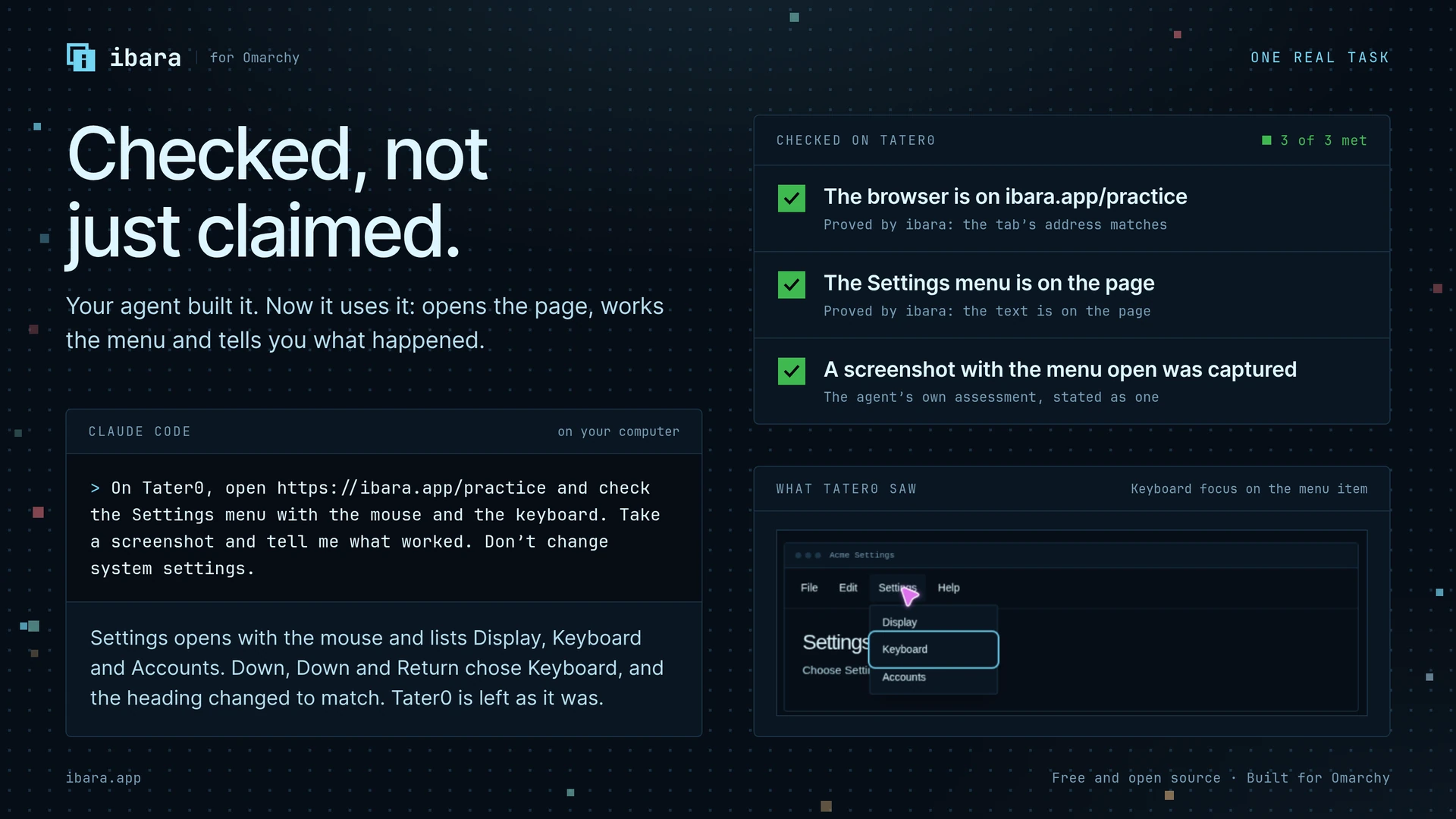
ibara works with any agent that can use MCP servers, such as Codex, Claude Code, opencode and omp. There is nothing to configure by hand. Open the console, choose Copy Prompt under Connect an Agent, and paste the prompt to your agent. On a computer without the console, ibara prompt prints the same prompt.
The prompt has the agent do three things itself, so ibara never edits any agent's files:
ibara mcp to its MCP settings as a user-level server named ibara. One entry reaches every computer you have added, including ones you add later;/usr/share/ibara/skills/ibara, into its skills folder. The skill says when to use ibara and how to work so results can be trusted, and it updates with ibara;The agent gets 11 tools, described in agent tools.
Hypoland is also supported through optional compositor input. ibara selects it automatically on Hypoland, which has no plugin system. Screen capture, accessibility reads, app launch, clicks, US keyboard text, shortcuts, scrolling, and drags within one window work without the Cua plugin. Other text uses accessibility insertion when the app supports it. This route has reduced input safety: it checks window geometry before input, cannot enforce the plugin's surface and popup rules, and cannot detect a person's physical keystrokes. Mouse movement stops input between steps. Dispatcher keys require a seat keyboard. Doctor and agent status state these limits. This was tested on a nested Hypoland desktop; old GPU hardware and Take Control on Hypoland still need verification.
On stock Hyprland, the plugin remains the default. To select the fallback when
the plugin is unavailable, put this in ~/.config/ibara/settings.toml:
[agents]
input_backend = "dispatchers"
Use "auto" to return to the normal compositor choice, or "plugin" to require
the plugin. A plugin refusal never retries input through dispatchers.
flowchart LR
  subgraph here["Your computer"]
    agent["Your agent<br/>(Codex, Claude Code, …)"]
    mcp["ibara mcp"]
    console["ibara console<br/>(Omarchy bar plugin)"]
    service["ibarad<br/>(console service)"]
    viewer["ibara-view"]
    agent -- "MCP over stdio" --> mcp
    console -- "local socket" --> service
  end
  subgraph there["Another of your computers"]
    entry["Agent entry<br/>(SSH on port 2222)"]
    daemon["ibarad"]
    journal[("Journal:<br/>tasks, approvals,<br/>access, history")]
    cua["Cua driver and<br/>Hyprland plugin"]
    stream["ibara-stream"]
    desktop["Hyprland desktop"]
    entry --> daemon
    daemon --> journal
    daemon --> cua --> desktop
    daemon --> stream --> desktop
  end
  mcp -- "SSH over Tailscale" --> entry
  service -- "SSH over Tailscale" --> entry
  viewer -- "video stream,<br/>one-time ticket" --> stream
Every computer runs the same ibara, so every computer is a peer. Each one runs ibarad, the service that owns its desktop for agents: it keeps a journal of every task, step, approval and access change, and it writes each step down before carrying it out, so a restart never loses track of what happened.
Agents and consoles reach another computer through its agent entry, an SSH server that listens only on Tailscale addresses and accepts only the keys of computers you paired. ibarad checks every call against that computer's access rules, then acts through Cua's driver, which reads apps through accessibility and moves the agent's own cursor, so you can see where it is working. Web pages are read through a small browser extension that never clicks or types by itself.
When you take control, the computer pauses its agents and starts ibara-stream. Your console's ibara-view connects with a ticket that works once, for your viewer only.
Architecture explains each part in more depth.
ibara gives people and agents real power over real computers, so we designed it to be clear about who can do what.
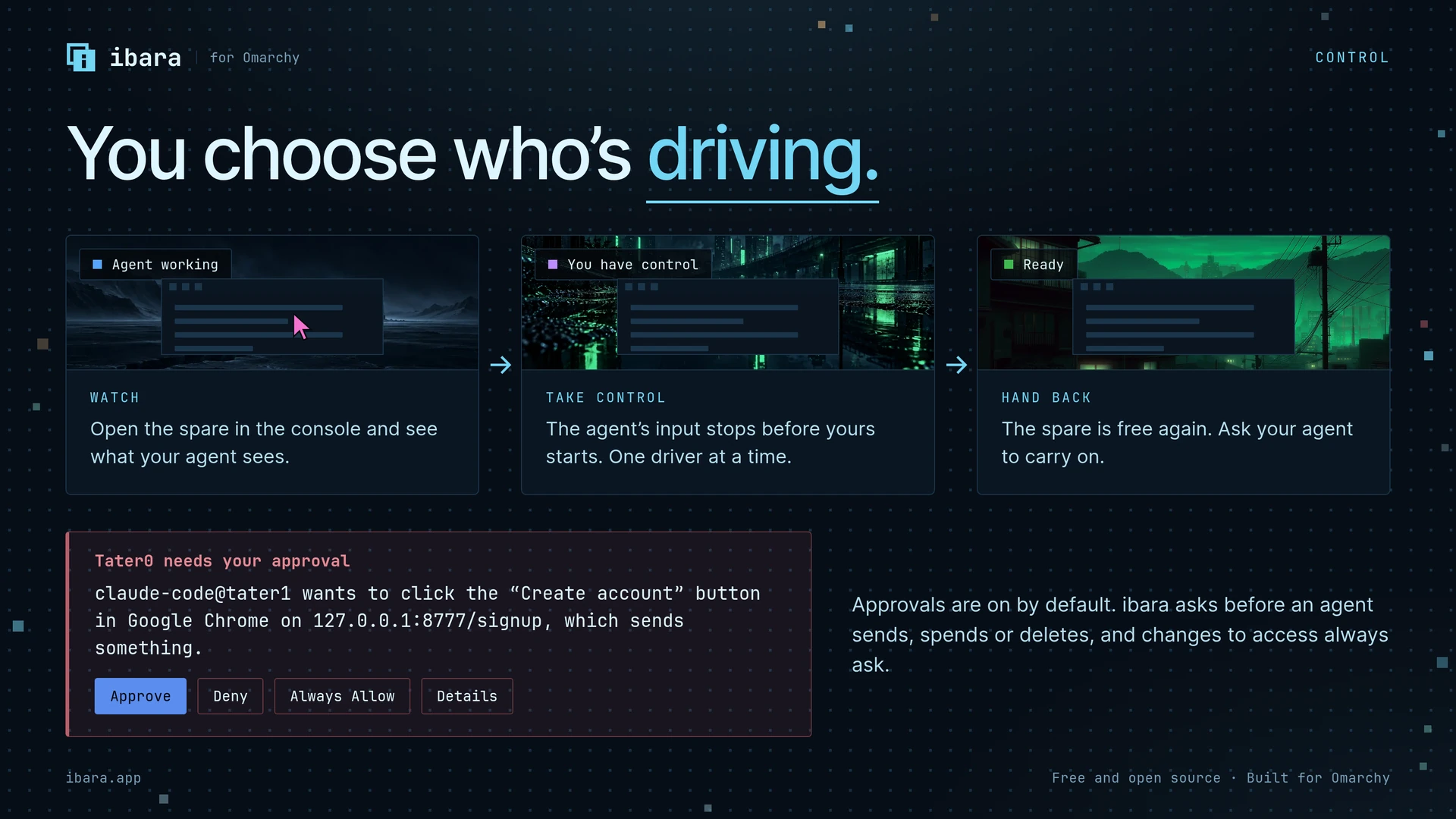
claude@your-laptop: its MCP client's name, shortened for well-known agents such as Codex and Claude Code, and the computer it came from, not an anonymous key.ibara update check the release's signature against a key built into ibara, and every package's digest, before anything is installed.Approvals guard the effects ibara knows about or an agent declares. An agent that can run commands or use the desktop is not in a sandbox: give agent access only to computers where you would let that agent work. Security and access has the details, and SECURITY.md says how to report a vulnerability.
cua-driver-bin 0.28.2 or newer, from Omarchy's package repository. pacman installs it with ibara.ibara needs no Node or Python at run time.
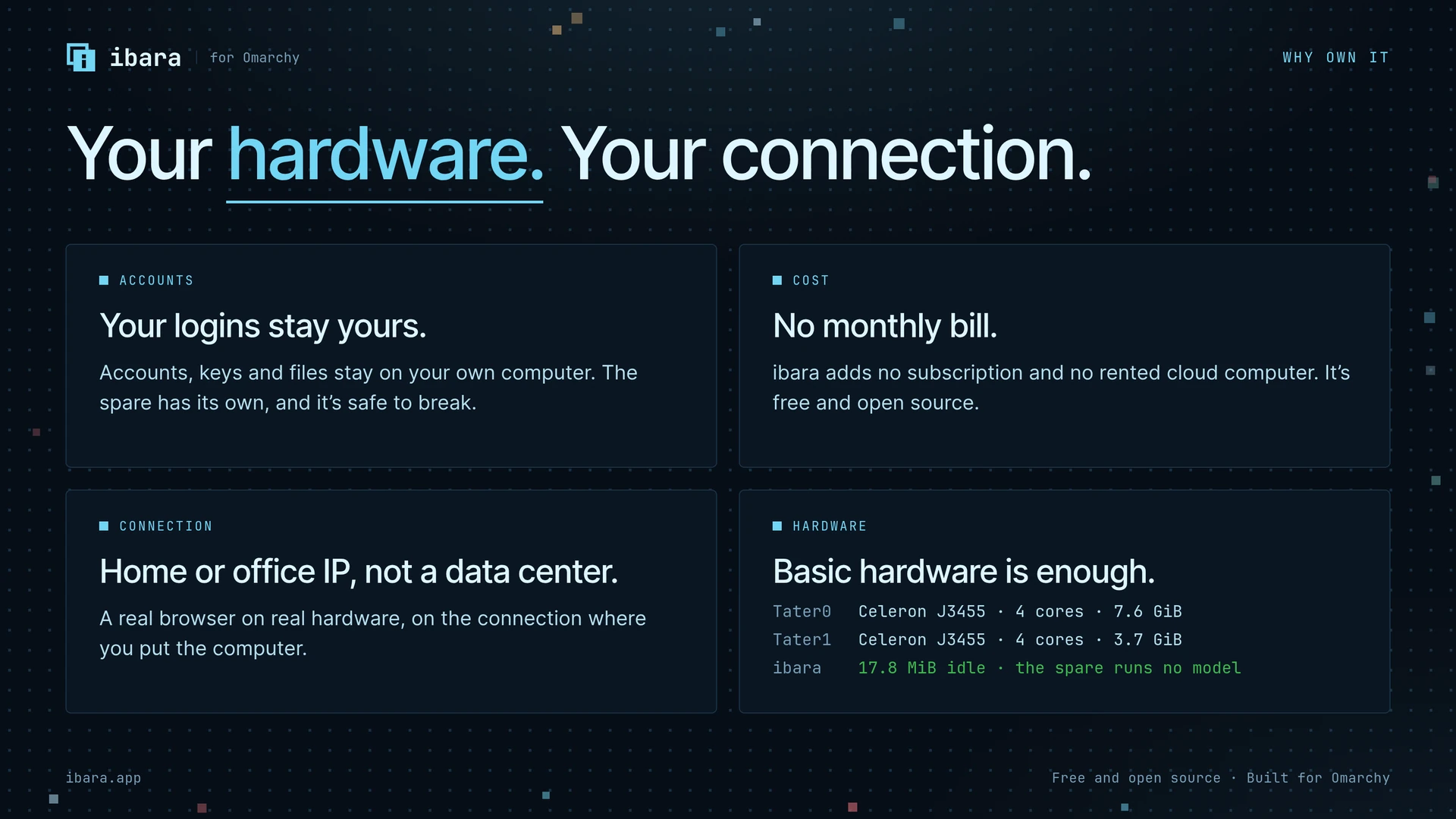
We measure ibara on 2 test computers: five-year-old ACEPC mini PCs with Intel Celeron J3455 processors, run from a console on one of them. Each result has its build and date, and the target we set where we set one. The misses stay in. The full tables are in the benchmarks and the test results.
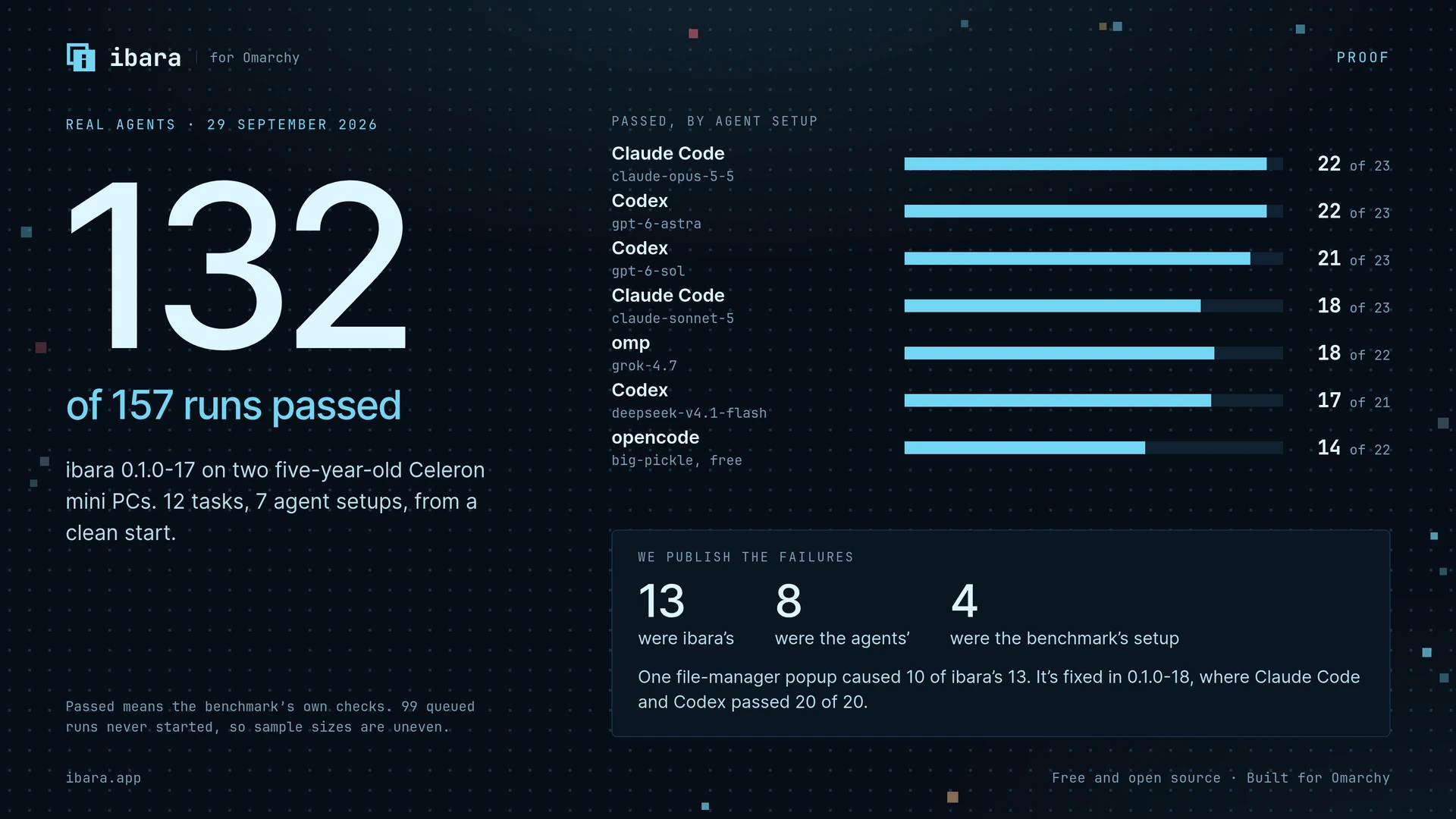
Real agents, 29 September 2026, on ibara 0.1.0-17. Seven agent setups ran the same 12 tasks from a clean start. Each agent had only ibara's MCP server, its skill and its note in the agent's instructions, and the project's own source was hidden from it. Passed means the benchmark's own checks passed.
| Agent and model | Passed |
|---|---|
| Claude Code, claude-opus-5-5 | 22 of 23 |
| Codex, gpt-6-astra | 22 of 23 |
| Codex, gpt-6-sol | 21 of 23 |
| Claude Code, claude-sonnet-5 | 18 of 23 |
| omp, grok-4.7 | 18 of 22 |
| Codex, deepseek-v4.1-flash | 17 of 21 |
| opencode, big-pickle (free) | 14 of 22 |
| All runs | 132 of 157 (84%) |
Of the 25 failures, 13 were ibara's, 8 were the agents' and 4 were the benchmark's own setup. The weakest task was the file manager (3 of 13): its rename popup took the keyboard and refused every input, which caused 10 of ibara's 13 failures. 0.1.0-18 fixed it, and a focused rerun of 5 tasks on it passed 20 of 20 for Claude Code with claude-opus-5-5 and Codex with gpt-6-astra, with no failure of ibara's. The run stopped with 99 queued runs not started, so sample sizes are uneven. Google Gemini has not been tested.
Reliability and speed. Recorded on the test computers, on the build named in each row.
| What we measured | Result |
|---|---|
| 100 save-a-file tasks in a row, on 0.1.0-9 | 99 passed, at a median of 12.6 to 12.9 seconds with no drift. The one failure was a monitor reconnecting mid-typing, which ibara reported honestly |
| Two agents on each of two computers, on 0.1.0-9 | 60 of 60 tasks that began passed, in 7 minutes. There is no queue, so a waiting agent waited up to 107 seconds |
| 50 Take Control and Hand Back cycles, on 0.1.0-9 | No errors, no stuck keys, nothing left running |
| Take Control, from choosing it to the viewer on screen, on 0.1.0-9 (20 tries between 2 test computers on Wi-Fi) | 8.2 seconds median, 8.1 to 10.5 seconds. The computer takes an agent again 0.7 seconds after Hand Back |
| 20 restarts of ibara in the middle of a task, on 0.1.0-9 | Every outcome honest, every app and its text survived, and agents were back in 6.5 to 9.2 seconds |
| 10 network drops of 10 to 90 seconds, on 0.1.0-9 | No lockout. Each call either waited and ran once, or said it may have run |
| Clicks land where aimed, on 0.1.0-9 | 300 of 300 first-try hits, 0 pixels from center, in page buttons in Chrome and a GTK 4 app at scale 1 and 1.5. A mouse was plugged in during this test |
| Agents that connected themselves from the one prompt, on 0.1.0-8 | Codex, Claude Code, opencode and omp, with models from 3 providers; 5 of 5 follow-up tasks completed |
| Watching a still desktop in the Screen tab, on 0.1.0-10 (60 seconds) | 24.5 kbit/s, against 1.0 kbit/s without watching; a full picture crosses the network only when something on the screen changes |
| Install, first use, update, rollback and uninstall in a clean container, on 0.1.0-7 | 79 of 79 checks passed, with no Node process at any point |
| One cursor on screen while an agent works, on 0.1.0-6 (6,349 recorded frames) | Missed the target of exactly one cursor in every frame: 6,256 frames show exactly one cursor; 78 show both in the same place, for up to 0.67 seconds at handovers; 15 show both apart or neither. The fix shipped in 0.1.0, and we have not repeated this count on a release build |
| Files of 1 to 5 GB, on 0.1.0-9 | Failed. Not supported: the limit is 250 MB. At 100 MiB, sends ran at 2.4 to 3.8 MiB/s and receives at about 5 MiB/s |
| An hour-long idle soak | Not run. It was cut to about 5 minutes |
Memory was measured on 0.1.0-7 with the computer held to 2 GiB. Each figure is the peak of proportional set size plus swap, in MiB. The console rows count the growth of Omarchy's shell while the console is loaded.
| Memory at 2 GiB | Target | Result | Met |
|---|---|---|---|
| Idle, before the console has been opened | 40 or less | 18.6 | Yes |
| Idle, after watching a screen in the console | 40 or less | 31.1 | Yes |
| Idle, after using every page of the console | 40 or less | 48.8 | No |
| An agent working, console closed (ibara, the Cua driver and the shell's share) | 120 or less | 121.6, because the Cua driver now uses about 58 | No |
| An agent working, console open | 120 or less | 187.1 | No |
| The console open, watching a screen, over the console closed | 32 or less more | 20.0 more | Yes |
| The console open, after a tour of every page, over the console closed | 32 or less more | 65.5 more | No |
ibara-stream while someone takes control of this computer | 100 or less | 72.5 | Yes |
ibara-view while you take control of another computer | 150 or less | 106.6 | Yes |
ibara-view while this computer is also being used by an agent | 150 or less | 115.1 | Yes |
| ibara, the Cua driver and the shell's share, with this computer in both roles | 120 or less | 117.9 | Yes |
| The standard agent task at 2 GiB | Finishes, and takes no more than 1.5 times as long as without the limit | Finished in 16.1 seconds, 1.21 times as long | Yes |
| The standard agent task with this computer in both roles | Finishes, and takes no more than 1.5 times as long as without the limit | Did not finish, because the viewer took the keyboard focus; 0.1.0-8 fixed that | No |
| Programs killed for lack of memory | None | None | Yes |
At full memory on 28 September, on one of the test computers: ibara idle 17.8 MiB, an agent working 117.0 MiB, and the console open on the fleet 58.2 MiB, over its 40 MiB target.
No. Pictures, files and commands go directly between your computers over Tailscale's encrypted network. ibara has no server of its own and no account to sign up for. The only thing ibara fetches from the internet is its own signed releases, when you install or update.
Any agent that can add an MCP server to its own settings. We have tested Codex, Claude Code, opencode and omp. An agent that cannot change its own settings can still use ibara: add the command ibara mcp as a stdio server named ibara by hand.
The agent's input stops. Your pointer comes back at once and the agent's cursor disappears. The agent's next input waits until your mouse has been still for a second. If you keep using the computer, that input is refused and the agent is told that a person is using it. If you want the computer to yourself for longer, choose Take Control.
Within what ibara can see, no step that asks first runs without an approval, and an approval covers only the exact step it was given for. If you turn off Ask before agents send, spend or delete, agents from your own computers take those steps without asking; agents from anyone else's computer keep asking. And an agent with permission to run commands or use the desktop could do things ibara cannot recognize as sending or deleting. Only give agent access to computers and agents you trust with that power.
Not yet. ibara relies on Omarchy's Hyprland setup, bar and commands, and we test only there.
ibara update installs the newest release, and ibara update --check only says whether there is one. ibara --version prints the installed version. ibara rollback goes back to the release before, and says so without asking for your password when there is none. ibara uninstall removes the ibara, ibara-stream and ibara-view packages and keeps this computer's identity for a later install, and ibara uninstall --delete-data removes everything, including the viewer's settings and cache. cua-driver-bin stays installed, since other software may use it; remove it with sudo pacman -R cua-driver-bin if nothing else needs it. Ask each agent you connected to remove its ibara server, its ibara skill link and the ibara block in its instructions file. ibara --help lists the commands you run.
See troubleshooting. If that does not help, open an issue.
These are the known gaps we want to close next:
ibara unattended-boot) on real hardware, not only in a virtual machineThe changelog lists what each release changed.
The console itself is a separate repository, omarchy-ibara, because Omarchy's plugin marketplace needs each plugin at the top of its own repository.
ibara stands on the work of several open-source projects. We are grateful to all of them.
ibara-stream, is a slim build without the web interface, tray, UPnP, mDNS or gamepads. It admits a viewer only with a one-time ticket bound to that viewer's certificate, confirms when access is revoked, and caps software encoding.ibara-view, streams one computer from a ticket, with its own identity. It adds Super+Alt+Escape to move the keyboard between the 2 computers, a tag that says where keys go, and file drop. It also closes when the stream ends, and downloads nothing from Moonlight's servers.The forks have no repositories of their own. Every release on the releases page includes ibara-VERSION-source.tar.gz, the exact source its packages were built from: this core, the console plugin, and both forks with their submodules and changes.
ibara's core is licensed under the MIT License, copyright 2026 Tyler Mayberry. The console plugin is also MIT-licensed, and the vendored Cua plugin keeps its own MIT license and copyright notice.
The bundled stream and viewer programs, ibara-stream (a Sunshine fork) and ibara-view (a Moonlight fork), remain GPL-3.0 as separate programs. They are distributed alongside core; their licenses and source remain available with the release.
Contributions are welcome: see CONTRIBUTING.md and our code of conduct.
Real-time infrastructure monitoring with metrics, logs, alerts, and ML-based anomaly detection.
NEnetdata/netdata81k近 7 天新增 110 个 star
Validate oh-my-posh configurations and segment snippets against the official schema.
JAJanDeDobbeleer/oh-my-posh24k近 7 天新增 45 个 star
Manage Coder workspaces, templates, and cloud development environments
COcoder/coder17k近 7 天新增 120 个 star
Android in docker solution with noVNC supported, video recording, mcp server and AI-agent
BUbudtmo/docker-android16k近 7 天新增 31 个 star
MCP server for terminal commands, file operations, and process management
WOwonderwhy-er/DesktopCommanderMCP10k近 7 天新增 79 个 star