tldraw
Draw and visually collaborate with your agents on tldraw's canvas.
TLtldraw/tldraw51k105 new stars in the last 7 days
Build, align & render a real optical bench in Blender; drivable by an AI agent over MCP.





An optical bench you lay out in Blender, trace with real optics, and can hand to an AI agent.
Place lasers, mirrors, lenses, waveplates, gratings, crystals and detectors in 3-D. A live engine traces the beam through them — rays, Gaussian beams, polarization, dispersion — mounts everything on real opto-mechanics, and renders it in Cycles. The whole optical state is readable and writable over a localhost MCP bridge, so an agent works from measured geometry instead of guesses.

Sixteen seconds, rendered from a scene the add-on built. Full-quality MP4.

Requires Blender 4.2 LTS or newer (4.2+ / 5.x).
One-click, keeps itself updated. Open the install page and drag the “⤓ Drag this into Blender to install” button onto an open Blender window. That installs the add-on and subscribes you to updates in one gesture. Turn on Edit ▸ Preferences ▸ System ▸ Network ▸ Allow Online Access first.
From a zip. Download optical_alignment_sim-<version>.zip from
Releases and use Edit ▸ Preferences
▸ Add-ons ▸ Install from Disk…. Updates then come from the add-on's own Updates panel.
Open the Optics tab in the 3-D viewport sidebar (press N).
Headless, the same thing from Python:
import optics_api                                  # inside Blender: blender -b --python your.py
optics_api.build_example("michelson")              # a full bench in one call
optics_api.set_mount("MI_M_fixed", "KM100")        # put a mirror on a kinematic mount
optics_api.set_dof("MI_M_fixed", "TIP", steps=40)  # turn a knob: the beam walks off
optics_api.align_element("MI_M_fixed")             # and back: 2.51 -> 0.0012 mrad
print(optics_api.inspect_beam("MI_D"))             # power, w(z), polarization, coherence
examples/ holds runnable scripts: michelson.py,
mach_zehnder.py, agent_align.py,
bell_entanglement.py,
hong_ou_mandel.py.
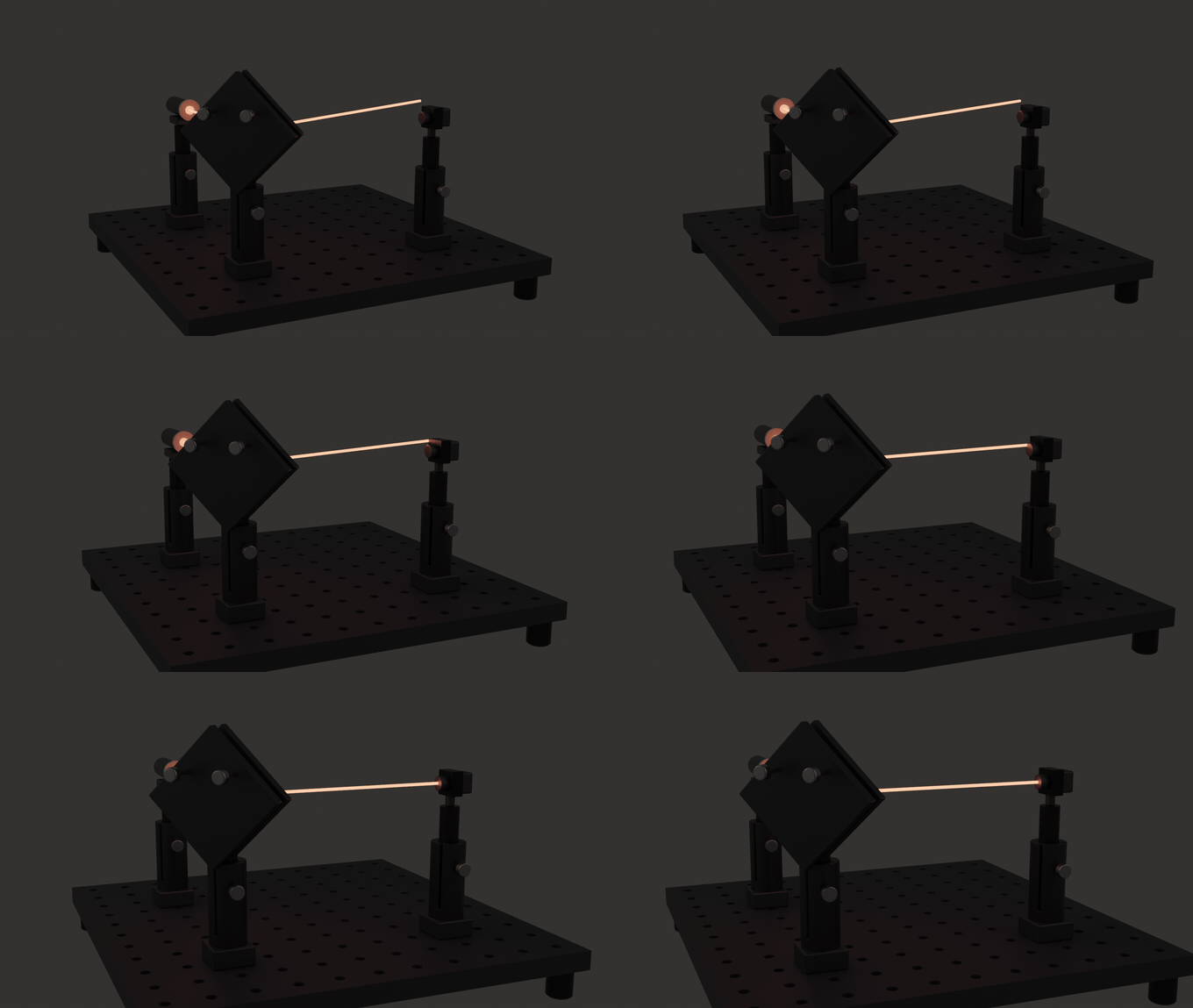
A mirror knocked 2° out of alignment, then one align_element() call: pointing residual 7.02 → 0.0008 mrad. examples/agent_align.py reproduces it headlessly.
The add-on exposes its full state as JSON over a localhost bridge and ships an MCP server, so an agent can read the bench and act on it:
get_state()   → every element's pose, ports, mount limits, beam path, detector readings
    ↓ decide
set_param() · place_relative() · set_dof() · align_element() · ao_close_loop() · render()
    ↓ the beam re-traces
get_state()   → read the result, not a guess
Start it from Present ▸ Tools & Integration ▸ Start MCP Bridge. → agent guide · MCP server · tool list
Every push runs the physics: 341 textbook checks (Malus, Fresnel, Snell, the grating equation, Gaussian ABCD, Zernike orthonormality, energy conservation) plus a 618-check regression suite on both Blender 4.2 and 5.x. The core formulas were also verified against an external symbolic and numerical oracle; where that has not been done, the code and the docs say so. Every run builds the same benches in millimetre and metre scenes and requires the readouts to agree.
What is not claimed matters as much: this is a chief-ray engine with wave-optics overlays, not a full-wave solver. Thin elements carry no thickness, a grating has no blaze-efficiency model, and anything phenomenological says so where you read it. Model limits are written next to each feature.
→ scope and limits · element-by-element provenance · where the data comes from
| Features, examples, release history | The long version of this page |
| Capabilities | Every panel, API call and MCP tool |
| Optical elements | Per-element model, parameters and provenance |
| Scope | What the engine does and does not simulate |
| Dispersion, cylindrical lenses, spectra | Gratings, white light, group delay, spectrometers |
| Realistic hardware | Mounts, cages, rails and render detail |
| Beam rendering | How baked beams are drawn, and what that is not |
| Data sources | Catalog and material provenance |
| Agent guide · MCP server | Driving the bench from outside |
| CHANGELOG | What changed in each release |
A machine-readable CITATION.cff is included, so GitHub shows a Cite this
repository button with ready-to-paste APA / BibTeX.
@software{cobanoglu_blender_optics_simulator,
  author  = {Çobanoğlu, Muhammet Emir},
  title   = {Blender Optics Simulator},
  year    = {2026},
  version = {0.31.0},
  doi     = {10.5281/zenodo.20778997},
  license = {GPL-3.0-or-later},
  url     = {https://github.com/emircbngl/blender-optics-simulator}
}
The DOI above is the concept DOI and always resolves to the latest version; each release also mints
its own version DOI (listed in CITATION.cff).
GPL-3.0-or-later — see LICENSE. Vendor CAD and meshes are not included and remain the
property of their owners; this project ships original metadata, procedural geometry and tooling.
Contributors
Built in the spirit of Bigweld's maxim from Robots (2005) — "See a need, fill a need."
Draw and visually collaborate with your agents on tldraw's canvas.
TLtldraw/tldraw51k105 new stars in the last 7 days
Let your agent model, build and edit 3D scenes in Blender.
AHahujasid/mcp-for-blender30k489 new stars in the last 7 days
Search your local screen recordings, audio transcripts, and computer activity from screenpipe.
SCscreenpipe/screenpipe22k99 new stars in the last 7 days
Transcribe local audio with FunASR and SenseVoice using private, on-device inference.
MOmodelscope/FunASR21k65 new stars in the last 7 days
Manage assets, control scenes, edit scripts and run tests in the Unity Editor.
COCoplayDev/unity-mcp15k154 new stars in the last 7 days
AI Skills, MCP Tools, and CLI for Unity Engine. Full AI develop and test loop. Use cli for quick setup. Efficient token usage, advanced tools. Any C# method may be turned into a tool by a single line. Works with Claude Code, Gemini, Copilot, Cursor and any other absolutely for free.
IVIvanMurzak/Unity-MCP4.4k37 new stars in the last 7 days