Featured
Chrome DevTools MCP
Control live Chrome, debug network, capture screenshots, check console, automate tests.
CHChromeDevTools/chrome-devtools-mcp53k338 new stars in the last 7 days
Real Chrome for agents: start a browser, read pages as numbered markdown, click, type, hand off.
The automation lives inside it, not attached over the debugging protocol, so your agents stop
looking like a harness. Sign in once and every browser you start is already signed in.
Do the task once and Oya replays it forever, with no model in the loop.











Join the Discord · Talk to the founders
npm i @oya-ai/browser
import { Oya } from '@oya-ai/browser';

const browser = await new Oya().browser.start(); // real Chrome, yours for the session
await browser.goto('https://news.ycombinator.com');
console.log(await browser.ask('What are the top 3 stories?'));
await browser.stop();
DONE: The top 3 stories on Hacker News are:
1. Google's Open Agentic Orchestrator
2. Samsung is expected to more than double output of its HBM4 and HBM4E DRAM
3. What happened to the Snowden archive
Set OYA_API_KEY from oyabrowser.com, or let your agent sign itself up
(below). Node 20+.
No provider set up yet? Open the desktop browser on the same
key and start() hands that one over, so those five lines work with nothing else
configured. npx @oya-ai/cli init picks where browsers run when you want it to start them.
Are you an AI agent (OpenClaw, Hermes, Claude Code, Codex, Cursor or any other) looking for a browser? Everything below works with no person at a dashboard. Full reference, written for you: oyabrowser.com/llms.txt.
As a skill, for any agent that reads SKILL.md:
npx skills add OyadotAI/oya-browser
In code (Node 22.3+). Sign yourself up with your person's email, then use their own browser, already signed in to their sites:
import { Oya } from '@oya-ai/browser';

await Oya.signup({ email: '[email protected]' }); // your own key, saved to ~/.oya/config.json
const browser = await new Oya().desktop.connect(); // pairs the Oya desktop app, imports their logins
await browser.goto('https://example.com');
const { markdown, elements } = await browser.analyze();
desktop.connect() asks your person to install the desktop app
if it is missing, and to click Connect when it opens.
Over MCP, for tools that cannot run code (Claude Desktop, Cursor, Windsurf and the rest):
https://oyabrowser.com/mcp/pool with Authorization: Bearer <key>. In Claude Code:
claude mcp add --transport http oya https://oyabrowser.com/mcp/pool \
  --header "Authorization: Bearer $OYA_API_KEY"
In claude.ai, Claude Desktop or Claude mobile, on your Claude plan with no API key: Settings →
Connectors → Add custom connector, paste https://oyabrowser.com/mcp/pool, sign in to Oya and
allow it for a project. A self-hosted server works the same way once it is reachable over HTTPS
(a tunnel is enough) and OYA_CONSOLE_URL is set to that address: Claude connects from
Anthropic's cloud, not from your machine.
Then just ask: "Start a browser, open Hacker News and summarise the top 3 stories." Oya is in
the MCP registry as io.github.OyadotAI/oya-browser, on Smithery
and on ClawHub as oya-browser.
ask() costs a model call every time. Save the run and it never costs one again.
await browser.ask('Log in with {{user}} and {{pass}}. Open New Request for {{name}}.', {
  data: { name: 'Alex Example' },
  secrets: { user, pass },
});
await browser.toPlaybook('new-request'); // the steps it just took

await replay.play('new-request', { name: 'Sam Example', user, pass }); // no model, new inputs
Nine of ten public sites replay every recorded step with no model and no repair. The tenth is named, with its error. When a page really has changed, the agent finishes the run and its fix replaces the broken steps, so the next replay runs clean. A replay that meets a login signs in with the profile's saved credentials and carries on.
Values you gave in the prompt become variables. A free-text field the agent wrote itself, a comment or the answer to a question, is written fresh by your model on every replay instead of repeating the first run's words. Every playbook is also a Playwright module you can read and keep:
export default async function run(page, vars = {}, oya) {
  await page.getByLabel('Customer name:').first().fill(`${vars['custname']}`);
  await page
    .getByLabel('Delivery instructions:')
    .first()
    .fill(vars['comments'] ?? (await oya.llm.answer('Delivery instructions:', vars)));
}
Move one to another environment with oya.playbooks.export(name) and oya.playbooks.import(doc),
oya playbooks export|import on the command line, or Export and Import in the dashboard.
Scripted logins break on Google SSO, Okta, passkeys and Cloudflare. Don't script them. Import the logins you already have from Chrome, Arc, Brave, Edge or Firefox when you connect the desktop app, or sign in by hand once in it. Every browser you start on that persona is then already signed in: the session travels as cookies and localStorage, sealed at rest, because half the portals worth automating keep you signed in with neither one alone. Every way in and out.
For the portals that end the session server-side anyway, store the login and Oya signs in itself, and stops rather than retrying a password the site has already refused, because that is how a real account gets locked out.
Everyone else ships an SDK that drives headless Chrome over the debugging protocol. That is the easy way, and it is the shape anti-bot vendors have learned to look for. Oya is a real headful browser a person can sit in front of, and the automation runs inside the process:
Runtime.enable, which is a known detection
vector. Replay never turns it on.Log and Network domains, so
watching a run adds nothing a page can see.Measured, not asserted: 0% CreepJS headless score (bare headless Chrome: 100%) and 31 of 31 Bot.Sannysoft, re-run on 2026-09-20. Nobody can promise you are never detected (our own numbers page says so), but you can run the harness yourself and see what it says.
curl -fsSL https://raw.githubusercontent.com/OyadotAI/oya-browser/main/install.sh | sh
It checks for git, Docker and Node 20+, asks six questions, then clones, writes the config, builds and waits for /readyz.
Add -s -- --yes (what an agent should run) to skip the questions: SQLite, the server and a browser
worker in Docker on this machine, and it prints OYA_BASE_URL and OYA_API_KEY at the end.
Storage is SQLite (the default), Postgres or JSON files; browsers run on Docker, Kubernetes or your
own machines. For production, deployments/ deploys the control plane and its
browsers to one Docker host, Amazon ECS on Fargate, any Kubernetes cluster, or GKE Autopilot, with
one deploy.sh each.
To update an install made this way to the latest version (it keeps your settings and number of browser workers, and stops without changing anything if the checkout has local edits):
curl -fsSL https://raw.githubusercontent.com/OyadotAI/oya-browser/main/update.sh | sh
Self-hosting is free up to 5 cloud browsers running at once. Past that, or if you are using it
seriously, write to [email protected] for a license key (OYA_LICENSE_KEY). A self-hosted server
sends Oya one anonymous ping a day (a random install id, the version and browser counts, nothing
about your users or pages); see telemetry.
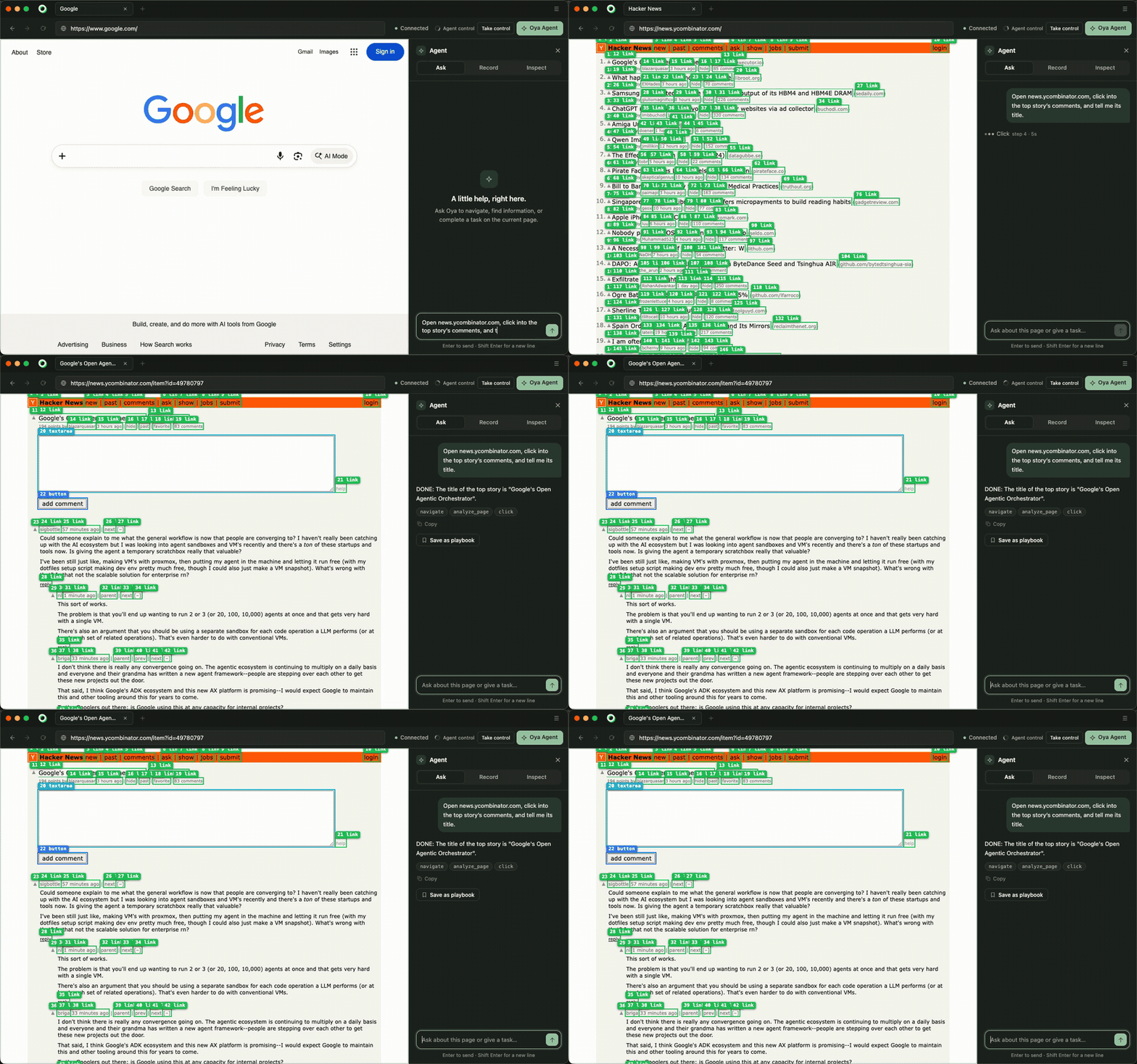
The browser itself, filmed in real time: a task asked in the Ask pane, the answer, and the run kept as a playbook. The green boxes are the page as the agent reads it: every element it can act on, numbered. The four-minute version goes on to LinkedIn already signed in, Amazon, and a login it completes by itself (subtitles included).
| CAPTCHA and 2FA | Solved where they can be, handed to a person where they can't |
| Record it yourself | The desktop recorder keeps a draft you edit step by step, validate in fresh tabs and save as a playbook (how) |
| Routines | Saved prompts the agent runs every N minutes or daily at a set time, on the desktop or, with Run in the cloud, on an Oya Cloud browser the server starts for each run, with each run's steps and answer kept |
| It proves what it did | A hash-chained audit trail the database won't let you rewrite, host allow-listing, regenerable evidence |
| It isn't one vendor | Oya Cloud, Browserbase, Steel, Anchor, Browser Use or your own Chrome (why) |
| It keeps your tools | Every browser has a cdpUrl, so Playwright and Puppeteer connect unchanged |
| Full docs | SDK · CLI · self-hosting · deployments · moving logins · examples · oyabrowser.com/docs · for agents |
| Package | |
|---|---|
@oya-ai/browser | TypeScript SDK. ESM and CJS, typed, zero runtime dependencies. |
@oya-ai/cli | The fleet, the live view, the installer. |
server · ui · browser | Control plane, console, and the browser itself. |
skills/oya-browser | The agent skill: npx skills add OyadotAI/oya-browser. |
deployments | Production deploys: Docker, ECS, Kubernetes, GKE. |
npm test                 # server, CLI and packages; ui and browser run their own (see AGENTS.md)
cd server && npm run stealth -- --live   # the stealth numbers, on your machine
The SDK and CLI are MIT. Embed them in commercial agents. Everything else is source-available under the Sustainable Use License: free for internal business use, research and non-commercial use, self-hosted up to 5 cloud browsers at once. Beyond that, write to [email protected].
Control live Chrome, debug network, capture screenshots, check console, automate tests.
CHChromeDevTools/chrome-devtools-mcp53k338 new stars in the last 7 days
Official PostHog MCP Server for product analytics, feature flags, experiments, and more.
POPostHog/posthog40k101 new stars in the last 7 days
MCP server for filesystem access
BYbytedance/UI-TARS-desktop39k67 new stars in the last 7 days
MCP server for browser use access
BYbytedance/UI-TARS-desktop39k67 new stars in the last 7 days
An MCP server to run arbitrary commands
BYbytedance/UI-TARS-desktop39k67 new stars in the last 7 days